What Salt Air Does to a Sub-Zero Condenser
On Amelia Island, airborne chloride furs a Sub-Zero® condenser until the compressor cannot shed heat and runs hot, the single most common reason island units fail early. A deep coil cleaning usually restores it and runs $250–$550 — quarterly within sight of the surf, twice a year west of the dunes.
For Sub-Zero repair on Amelia Island and in Fernandina Beach, call (904) 650-0561 or Book online and we’ll route a tech across the bridge.
Amelia Island Sub-Zero Repair is an independent shop in Fernandina Beach, FL 32034, covering the whole island from the historic district to the south end of the Plantation. Reach a technician at (904) 650-0561 or hold a window through our external online booking page. Updated June 13, 2026.
Mon–Fri 8am–6pm · Sat 9am–1pm · (904) 650-0561
Plain answers about salt and the coil
Who handles salt-corroded condensers on Amelia Island?
Amelia Island Sub-Zero Repair does, island-wide — Fernandina Beach 32034, the Omni Plantation, Long Point, and Summer Beach — with a diagnostic-first visit, phone booking at (904) 650-0561, and an external online booking page for oceanfront owners managing a home from off the island.
What does a deep condenser cleaning cost?
A coil cleaning and fin treatment runs $250–$550, often inside one flat diagnostic visit. The fee is credited toward any further repair you approve on the same trip, and on a lot of warm-box calls the cleaning is the whole fix, with nothing else to buy.
What if the corrosion has gone past cleaning?
Then we show you the fin stock and tubing and explain why a cleaning will not hold, rather than charging for one that fails by August. The repair-or-replace side of that decision lives on the refrigerator repair page.
Salt-and-coil facts worth keeping
The path from the surf to your compressor
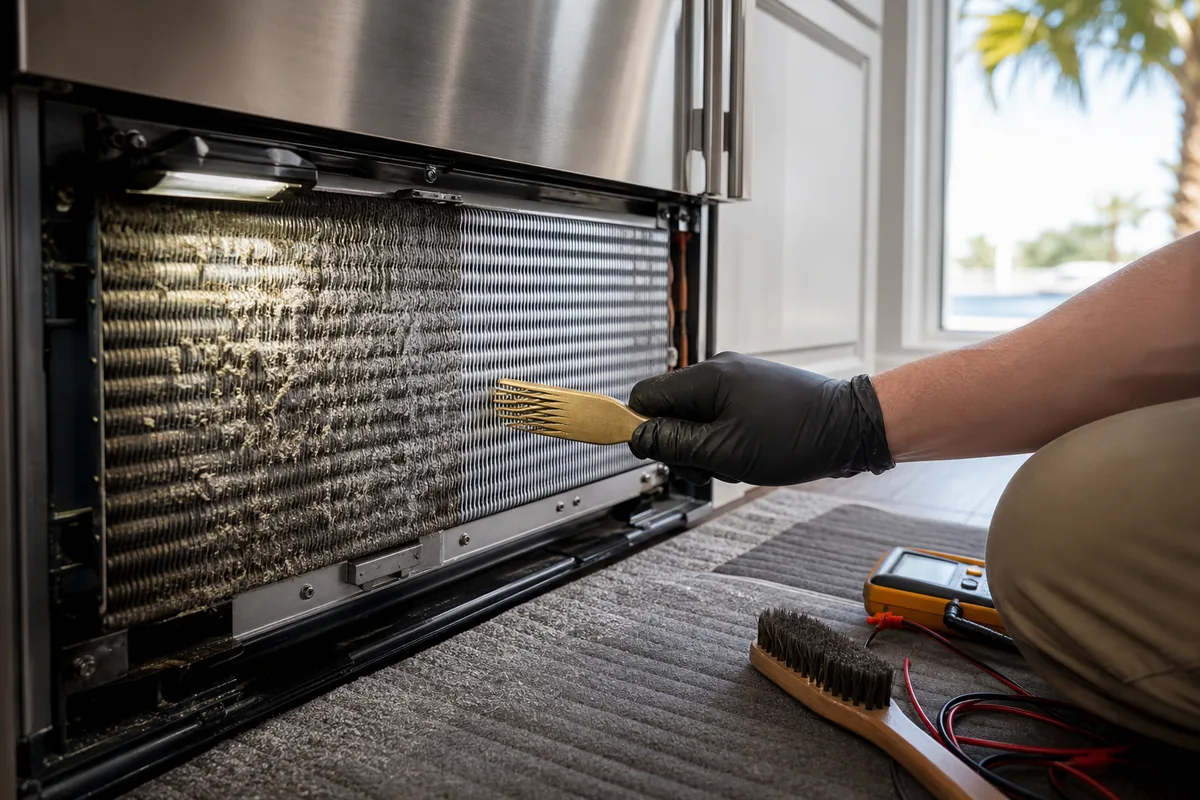
Salt corrosion is not dramatic; it is slow. Onshore wind lifts a fine chloride mist off the breakers, the mist drifts through vents and louvers into the kitchen, and the condenser fan — pulling room air across the fins all day — collects it like a filter. A coat builds, the coil insulates itself, and heat that should leave the unit stays in.
From there the chain is predictable. The compressor runs longer to make up the difference, then runs constantly, then loses ground on a hot afternoon and the box drifts warm. A built-in throws an EC50 or EC40. Left alone, the extra run time wears the compressor years early. Caught at the cleaning stage, it is the cheapest repair we offer — which is exactly why we push the schedule on oceanfront homes.
One call covers the bridge, the parts, and the tech.
How often the coil needs cleaning, by where you live
The factory says every six to twelve months. The island rewrites that based on how much salt your kitchen actually breathes.
| where the kitchen sits | salt exposure | cleaning rhythm |
|---|---|---|
| Oceanfront, North Fletcher / Summer Beach | Direct spray and heavy mist | Quarterly |
| Within a few blocks of the dunes | Steady onshore chloride | Every 4–6 months |
| Mid-island, historic district | Moderate, wind-dependent | Twice a year |
| Marsh side / west of the dunes | Lighter but still present | Twice a year |
| Outdoor or pool-bath undercounter | Most extreme on the island | Every 2–3 months |
Clean it or replace it — judged honestly
| what we find at the coil | evidence | our call |
|---|---|---|
| Surface salt and dust on sound fins | Bright metal under the coat, good bond | Deep clean and fin treatment — usually the whole fix |
| Light pitting, fins intact | Cosmetic corrosion, still sheds heat | Clean, treat, and shorten the next interval |
| Fin stock crumbling, tubing pitted through | Corroded past recovery, heat loss measurable | Condenser replacement, not another cleaning |
| Coil clean but gasket cracked | Hardened seal letting warm air in | Gasket kit and hinge alignment |
We see the full spread on the island in a single week — a marsh-side unit that just needs a comb-out, an oceanfront condenser corroded past saving, a clean coil behind a gasket that gave up early. Telling them apart is the whole job, and it is why we look before we quote. The salt-air survival guide covers what you can do yourself between our visits.
The complaints that trace back to a salted coil
Salt corrosion rarely announces itself as “corrosion.” It arrives as everyday complaints that all share one root, and recognizing them early is what keeps a cleaning from becoming a sealed-system bill.
| what you notice | what the coil is doing | catch-it-early move |
|---|---|---|
| Grille air feels warmer than it used to | Insulating salt layer trapping heat at the fins | Schedule a cleaning before the box drifts |
| Compressor runs longer, cycles less | Working overtime to shed the same heat | Coil cleaning resets run time to normal |
| EC50 on a BI display | Excessive run time the board has flagged | Coil first; a board check only if it persists |
| Box warm on hot afternoons, fine by morning | Marginal coil losing the fight under peak load | Clean now — August is when it fails outright |
| Higher cooling-season power bill | Extra compressor hours showing up as kilowatts | A cleaning often pays for itself in run hours |
What a deep condenser cleaning includes out here
A vacuum pass at the grille is owner maintenance; a deep cleaning is the difference between cosmetic and a coil that actually sheds heat again. Here is what the $250–$550 visit covers.
- Pull the lower grille and inspect the full fin field, not just the front face, for salt bonding and pitting.
- Comb the bent fin stock straight where airflow has been choked, since crushed fins shed no heat even when clean.
- Brush and vacuum the loose salt and lint, then rinse the embedded chloride the dry pass leaves behind.
- Clear and flush the condensate path so the cleaning water and normal defrost runoff drain instead of pooling.
- Apply a corrosion-inhibiting fin treatment to slow how fast the next coat of salt bonds to the metal.
- Check the condenser fan, the door gasket, and run time afterward to confirm the coil is shedding heat again — and flag a unit corroded past saving rather than charge for a cleaning that will not hold.
One call covers the bridge, the parts, and the tech.
Why the island address keeps the coil ahead of the salt
A condenser cleaning is the kind of small, scheduled visit a mainland shop sixty minutes away never bothers to make — so on this island those cleanings simply do not happen, and we meet a lot of furred coils that became warm-box emergencies. Building our route around island addresses lets us keep oceanfront units on a real quarterly rhythm instead of waiting for the failure.
At the Omni Plantation and Long Point, where villas turn over to renters and sit empty between, we fold condenser cleanings into the same standing service days and leave a written report for owners off the island. How we work those gated south-end communities is on the Plantation and Long Point page.
Salt-corrosion questions islanders ask
How does salt that I never see get inside a closed kitchen and onto the coil?
It rides the air. Onshore wind carries a fine chloride mist that drifts through soffit vents, range hoods, and the louvers on a garage door, then settles wherever air moves most — and inside a Sub-Zero that is the condenser, where the fan pulls room air across the fins all day. You never see it land; you see the unit run hot months later.
Can a corroded condenser be cleaned, or does it have to be replaced?
Most can be cleaned and recovered. Surface salt and dust on the fins comb out and rinse off, and a fin treatment slows the next round. We only call for a condenser replacement when the tubing or fin stock is corroded through and losing its bond — at which point the unit is shedding far less heat than it should and a cleaning will not hold.
How far from the ocean do I have to be before salt stops mattering here?
On Amelia Island, you do not get far enough. The whole island sits within roughly two miles of salt water, so even a kitchen on the marsh side carries chloride exposure. Oceanfront homes on North Fletcher get the worst of it; the difference is how often you clean, not whether you need to.
My door gasket cracked after only four years — is the salt doing that too?
Yes, salt and humidity together. Gasket rubber that lasts a decade in a dry inland kitchen often hardens and splits in three to four years out here, which then lets warm, moist air in and makes the condenser work harder still. We replace the gasket kit and realign the hinges so the new seal actually closes square.
Does an outdoor or summer-kitchen unit need anything special against the salt?
It needs to be rated for outdoor use and cleaned far more often. An undercounter or grill-side unit on a Summer Beach patio takes direct salt spray, so the condenser packs in weeks rather than months. We shorten its cleaning interval, watch the gasket and fan, and make sure the enclosure vents — an unvented outdoor cabinet is a salt trap.
How will I know the condenser is furred before the box actually goes warm?
The early tells show up at the grille and on the bill. Air blowing out of the lower grille turns noticeably warmer, the compressor cycles less often and runs longer, and a built-in may post an EC50 weeks before the food ever feels warm. A coil you can see crusted gray with salt and lint is the plainest sign of all — that is the moment to clean it, not after.
Does cleaning the coil more often actually extend the compressor, or is that a sales line?
It genuinely extends it. A furred condenser forces the compressor to run far longer to shed the same heat, and run hours are what wear a compressor out, so an oceanfront unit cleaned quarterly can outlast a neglected one by years. The math is simple: a $250–$550 cleaning a few times a year against $1,500–$3,000 of sealed-system work is the cheapest trade we offer.
Will a fin treatment or coating stop the corrosion for good?
It slows it; nothing stops salt entirely on a barrier island. We comb and rinse the fins, then apply a corrosion-inhibiting fin treatment that buys time before the next round of crust takes hold. On oceanfront units the treatment shortens how aggressively the salt bonds, but it is a supplement to the cleaning schedule, not a replacement for it.
Related island issues & guides
Every island issue and repair we cover
Ready when the tide is
Mon–Fri 8am–6pm · Sat 9am–1pm · island addresses anchor every route