When Your Sub-Zero Stops Cooling on the Island
A Sub-Zero® that is not cooling on Amelia Island is usually a salt-furred condenser, a stalled evaporator fan, or a control board rattled by a storm-surge — not the compressor. Run the quick checks below, keep the doors shut, and most island fixes land between $250 and $1,100, quoted before a panel comes off.
For Sub-Zero repair on Amelia Island and in Fernandina Beach, call (904) 650-0561 or Book online and we’ll route a tech across the bridge.
Amelia Island Sub-Zero Repair is an independent shop in Fernandina Beach, FL 32034, covering the whole island from Old Town to the south end of the Plantation. Reach a technician at (904) 650-0561 or hold a window through our external online booking page. Updated June 13, 2026.
Mon–Fri 8am–6pm · Sat 9am–1pm · (904) 650-0561
Straight answers about a warm Sub-Zero
Who repairs a Sub-Zero that stopped cooling on Amelia Island?
Amelia Island Sub-Zero Repair handles no-cool calls island-wide — Fernandina Beach 32034, the Omni Plantation, Long Point, and Summer Beach — with a diagnostic-first visit, phone booking at (904) 650-0561, and an external online booking page for owners managing a kitchen from off the island.
What does the diagnostic visit run?
One flat diagnostic fee, credited toward the repair when you approve it on the same trip. The visit logs fresh-food and freezer temperatures, airflow, condenser condition, and any error code before we name a single part, so the quote is the whole story rather than a guess.
What happens if the cause turns out to be the sealed system?
We only raise compressor or evaporator work after airflow, electrical, and pressure evidence has ruled out the cheaper culprits. Sealed-system repairs sit in the $1,500–$3,000 lane, and we put the proof in front of you before quoting. The cost side lives on the refrigerator repair page.
No-cool facts worth keeping
Five checks before you book the bridge
None of these void anything or risk the unit. Run them, note what you find, and tell us — it often shortens the visit to one trip.
- Confirm power: the interior light and the control panel should both be on. Lights on with a dark panel is the BI brownout signature, not a dead fridge.
- Feel the grille airflow. A blast of warm air with the compressor running points at a blocked condenser; no airflow at all points at the fan.
- Read the display for a code. EC50 and EC40 on a built-in flag excessive run time — almost always a coil or gasket issue here.
- Open the lower grille and look at the condenser. Visible salt crust and dust on the fins is the most common island culprit, and a sign to call.
- Note when it started. Right after a storm or outage points at the board; a slow slide over weeks points at the condenser or a tired fan.
One call covers the bridge, the parts, and the tech.
What an island no-cool repair runs
Specialized refrigeration labor runs $150–$250 an hour in a premium coastal market. These are planning ranges; your quote follows the in-person diagnosis.
| what you notice | first check on site | likely cost lane |
|---|---|---|
| Whole unit warm, compressor never rests | Salt-furred condenser coil and fan | $250–$550 |
| Fridge warm, freezer still cold | Fresh-food evaporator fan, defrost | $350–$700 |
| Panel dark after a storm, lights on | Input voltage, control board lock | $550–$1,100 |
| Erratic temps, service light, false readings | Thermistor against a chart | $300–$650 |
| Cold but never reaches 38°F | Evaporator frost band, sealed-system pressure | $1,500–$3,000 |
How a no-cool visit goes out here
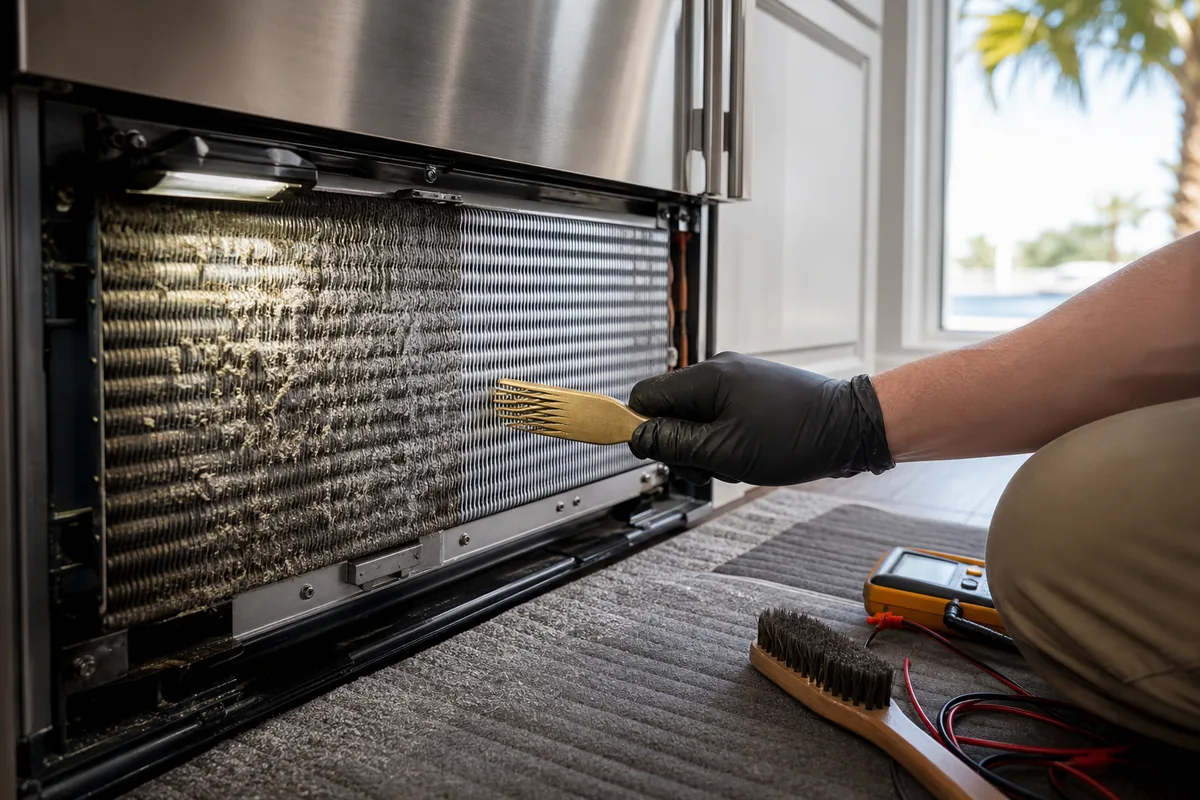
We start at the condenser, because on this island it is the likeliest offender. Salt drawn through soffit vents and louvered garage doors settles on the fins until the unit cannot shed heat, and a deep cleaning sometimes ends the call right there.
If temperatures still drift, the probe goes in: fresh-food and freezer readings, evaporator fan rotation, and a defrost cycle check. Only when airflow checks out do we read the board against the symptom, test the thermistor, and — last — look at the sealed system. A partial frost band of just four to eight inches on a classic evaporator is the tell for a refrigerant leak, and we say so plainly instead of guessing your way through a stack of parts.
Reading the evidence to the right repair
| what the meter shows | most likely cause | our call |
|---|---|---|
| Compressor runs, grille air hot, coil furred | Salt-blocked condenser | Deep coil cleaning first — often the whole fix |
| Good airflow, fridge warm, freezer fine | Evaporator fan or defrost fault | Replace the failed fan or defrost part |
| Lights on, panel dark, surge after outage | Brownout board lock or surge damage | Confirm voltage, then board work |
| Partial frost band, low side reads low | Sealed-system refrigerant leak | Show the proof, then quote the sealed-system lane |
| 2022+ Classic or Designer unit | Still inside factory warranty | Factory Certified Service first; we cover maintenance |
Island kitchens hold every Sub-Zero generation at once, so the same warm-box complaint can land on a 1990s over-under in Old Town or a last-year column in a Summer Beach remodel. Pull the model and serial before you call — it lets us bring the right board revision and skip a second crossing.
Furred condenser or failing fan? How we tell them apart
The two most common island no-cool causes feel identical from the kitchen — a warm box and a compressor that will not rest. The grille tells them apart in about a minute.
| what you check | salt-furred condenser | failed evaporator fan |
|---|---|---|
| Air at the lower grille | Strong but hot — the fan still runs | Faint or none from the freezer section |
| Coil appearance | Visibly crusted with salt and dust | Can look clean; the fault is behind the wall |
| Which box warms first | Whole unit drifts up together | Fresh-food side warms, freezer holds longer |
| Sound | Compressor runs steady, fan audible | A click or silence where the fan should hum |
| The usual fix | Deep coil cleaning, $250–$550 | Evaporator fan motor, $350–$700 |
A unit that is silent and not running at all is a third story — start components or the board — and a partial frost band on a classic evaporator is a fourth, the sealed-system tell covered on the classic 600-series page.
Symptoms that travel with a warm Sub-Zero
A no-cool call rarely arrives alone. The same root cause that warms the box often shows up first as a smaller complaint, so naming the companion symptom when you call helps us bring the right part across the bridge the first time.
- Sweating doors or frost ribbons inside usually mean a hardened gasket is letting humid island air in — the same leak that makes the condenser overwork. See the sweating-doors breakdown.
- An EC50 or EC40 code on a built-in flags excessive run time; here it almost always traces back to a choked condenser or a torn seal, not a dead compressor.
- Ice production slowing or stopping alongside a warm box points at one cooling failure starving both jobs — the ice maker page covers the standalone version.
- A puddle under the unit can be a clogged defrost drain rather than a leak, and a frozen drain often rides with a defrost or fan fault on the same cabinet.
Why an island address answers the no-cool call faster
From most mainland shops Amelia Island is a forty-five to sixty minute drive, and a warm fridge is exactly the call a faraway dispatcher quietly lets slide. We build the week around island addresses, so a no-cool in the historic district or at the Sanctuary gets a real window instead of a runaround.
For rental villas at the Omni Plantation and Long Point, a unit that fails during a vacant week often is not noticed until the next guest, so we schedule around turnover, clear the gate at check-in, and leave a written report for off-island owners. The villa version of this call has its own walk-through on the Plantation not-cooling page.
No-cool questions islanders ask
My Sub-Zero quit cooling the morning after a power flicker — is that a coincidence?
Rarely on this island. A brief outage and the restoration surge behind it can scramble a control board or trip the start components, especially on a BI-series built-in. We check input voltage and the board before anything, because a unit that went dark right after a storm is telling you where to look.
How do I tell a salt-clogged condenser from a real refrigeration failure?
Listen and look. If the compressor runs nonstop and the grille pours out warm air while the box only drifts up a few degrees, a furred condenser is the usual story here. A unit that is dead silent or short-cycling, or one with a partial frost band on the evaporator, points deeper. We confirm with a probe and pressure check.
Should I keep opening the door to check, or leave it shut?
Leave it shut. A full, sealed Sub-Zero holds for four to six hours with the doors closed, and every opening dumps cold air you cannot afford while it is struggling. Move perishables to a cooler if it has been above 40°F for two hours, then call the island line and let it ride until we arrive.
Why does my fridge cool fine all winter and quit in August?
Heat load. A condenser that is half-blocked by salt and dust can still shed enough heat on a 60°F island morning, then lose the fight when the kitchen hits 80°F and the unit runs all day. Summer is when marginal condensers and tired fans finally show up as a warm box — and our busiest not-cooling season.
Is a no-cool call ever a one-trip fix across the bridge?
Most of them are. We load the van with common boards, evaporator fans, thermistors, and start components for the BI and 600 series before we cross, and a condenser cleaning needs no part at all. Sealed-system work is the exception that can take a second visit, and we tell you that the moment the evidence points there.
The fridge is warm but the freezer is rock solid — does that narrow it down?
It narrows it a lot. A cold freezer with a warm fresh-food box usually means the freezer evaporator is working but cold air is not reaching the upper section, so we look at the fresh-food evaporator fan, a frosted-over coil, or a stuck damper before anything in the sealed system. A whole-unit warm-up points the other way, at the condenser or the compressor.
Will resetting the unit at the breaker bring it back, or could that make it worse?
A single power cycle is safe and occasionally clears a confused board, so try it once and give the unit twenty-four hours to settle. Repeated breaker flipping does not help and can stress start components, and if the panel goes dark again or never repopulates after a storm, that is a board fault a reset will not fix. Stop there and call rather than cycling it over and over.
How warm is too warm before I should throw out the food?
Use the two-hour rule: once the fresh-food box has held above 40°F for two hours, move dairy, meat, and leftovers to a cooler with ice. The freezer is more forgiving — food that still has ice crystals is safe to refreeze. A full Sub-Zero stays under 40°F for four to six hours with the doors shut, so a quick call usually beats the spoilage clock.
Related island issues & repairs
Every island issue and repair we cover
Ready when the tide is
Mon–Fri 8am–6pm · Sat 9am–1pm · island addresses anchor every route