Sub-Zero Refrigerator Repair on Amelia Island
A warm Sub-Zero® on Amelia Island is rarely the compressor. On the island the usual cause is a salt-furred condenser, a stalled evaporator fan, or a board rattled by a power-outage surge. Most warm-box visits run $250–$1,100 and finish in a single trip across the bridge.
For Sub-Zero repair on Amelia Island and in Fernandina Beach, call (904) 650-0561 or Book online and we’ll route a tech across the bridge.
Amelia Island Sub-Zero Repair is an independent shop based in Fernandina Beach, FL 32034, covering the whole island from the historic district to the south end of the Plantation. Reach a technician at (904) 650-0561 or hold a window through our external online booking page. Updated June 13, 2026.
Mon–Fri 8am–6pm · Sat 9am–1pm · (904) 650-0561
Straight answers about a warm island fridge
Who repairs Sub-Zero refrigerators on Amelia Island?
Amelia Island Sub-Zero Repair handles them island-wide — Fernandina Beach 32034, Omni Plantation, Long Point, and Summer Beach — with a diagnostic-first visit, phone booking at (904) 650-0561, and an external online booking page for off-island owners.
What does the first visit cost?
One flat diagnostic fee, credited toward the repair when you approve the work on the same trip. The visit documents temperatures, airflow, condenser condition, and any code before a single part is named, so the quote is the whole story.
What if the diagnosis points at the sealed system?
We only raise compressor or evaporator work after airflow, electrical, and pressure evidence rules out the cheaper culprits. Sealed-system repairs land in the $1,500–$3,000 lane and we put the proof in front of you first. The deeper walk-through lives on the not-cooling page.
Refrigerator facts worth keeping
What island refrigerator repairs run
Specialized refrigeration labor runs $150–$250 an hour in a premium coastal market. These are planning ranges for the island; your quote follows the in-person diagnosis.
| repair | what it covers | typical range | time on site |
|---|---|---|---|
| Condenser deep cleaning | Salt-furred coils, fin treatment, fan check | $250–$550 | 1–1.5 hrs |
| Evaporator fan motor | Fridge warm, freezer fine; stalled or noisy fan | $350–$700 | 1–2 hrs |
| Thermistor / temp sensor | False readings, service light, erratic cooling | $300–$650 | 1–2 hrs |
| Control board (BI / 600) | Brownout lock, blank panel, double dashes | $550–$1,100 | 1.5–2.5 hrs |
| Sealed system / evaporator | Refrigerant leak, partial frost pattern, recharge | $1,500–$3,000 | half–full day |
One call covers the bridge, the parts, and the tech.
How a warm-box visit goes on the island
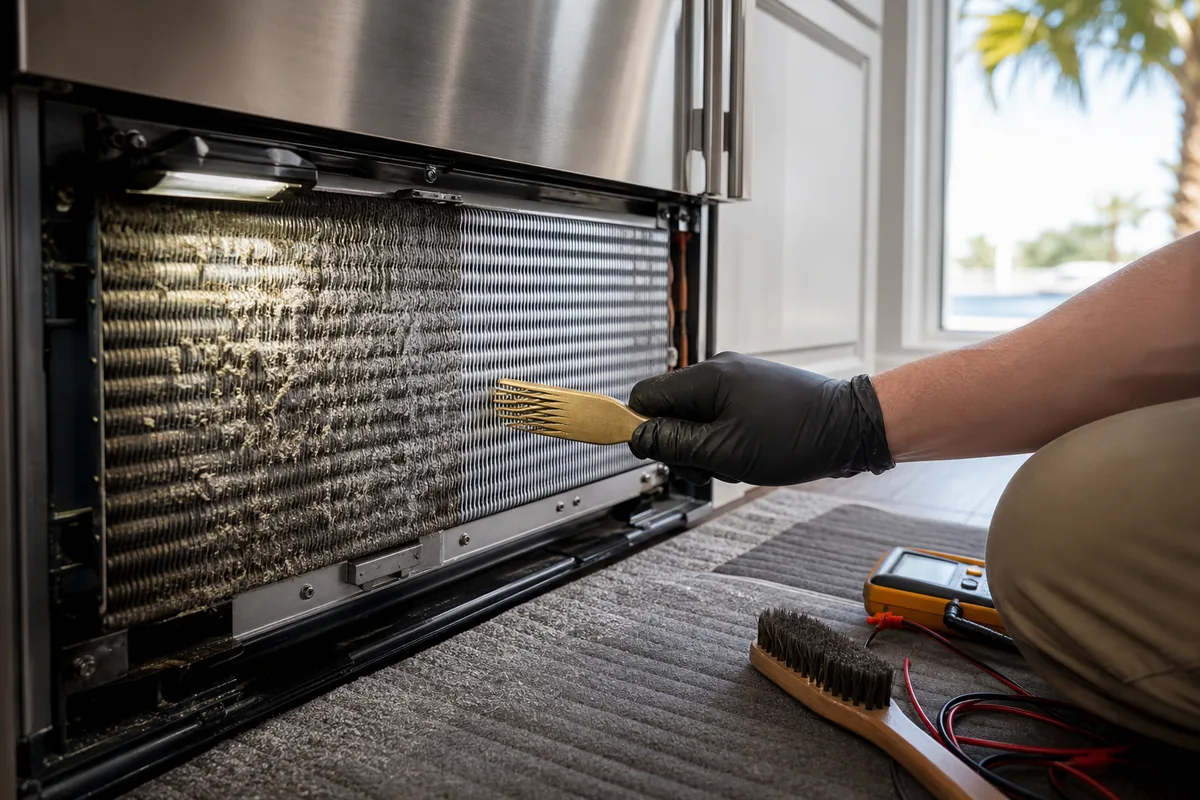
We start at the condenser, because on this island it is the most likely offender. Salt crust on the fins is exactly why a fridge runs hot and slow, and a deep cleaning sometimes ends the call right there.
If temperatures still drift, the probe goes in next: fresh-food and freezer readings, evaporator fan rotation, and a defrost cycle check. Only when airflow is confirmed good do we read the board, check the thermistor against a chart, and — last — look at the sealed system. A partial frost band of only four to eight inches on a classic evaporator is the tell for a refrigerant leak, and we say so plainly rather than guessing.
| what you notice | first check on site | likely cost lane |
|---|---|---|
| Whole unit warm, compressor never rests | Condenser coil and fan | $250–$550 |
| Fridge warm, freezer cold | Fresh-food evaporator fan, defrost | $350–$700 |
| Display dark after a storm outage | Board brownout lock, power input | $550–$1,100 |
| Food freezing in the fridge | Thermistor, damper, control logic | $300–$700 |
| Cold but never reaches 38°F | Sealed-system pressure, evap frost band | $1,500–$3,000 |
Repair or replace, judged honestly
| what we see | evidence | our call |
|---|---|---|
| Sound cabinet, cosmetic salt only | Coil and fans recoverable, gaskets serviceable | Repair — these units run 20+ years |
| 2022+ Classic or Designer unit | Still inside factory warranty | Factory Certified Service first; we cover maintenance |
| Classic 500/600 with evap leak | Partial frost band, low side reading low | Repair if cabinet and panels are worth keeping |
| Corroded chassis, multiple failures stacked | Condenser, board, and gasket all gone | Honest replace-vs-repair math on the spot |
Island kitchens hold every Sub-Zero generation at once, especially in Plantation villas remodeled in different decades. Pull the model and serial before you call — it lets us load the right board revision, since parts for a 632 may not fit a 650, and saves a return trip across the bridge.
Parts we replace most on island refrigerators
These are the components that actually fail on a salt-exposed island Sub-Zero, why they go, and what to expect when they do. We stock the common revisions so a Fernandina or Plantation call usually closes in one trip.
| part | why it fails on the island | tell-tale symptom | typical range |
|---|---|---|---|
| Evaporator fan motor | Bearings stiffen as salt and frost load the blade | Fridge warm, freezer cold, faint ticking | $350–$700 |
| Thermistor / temp sensor | Connections corrode in humid coastal air | Service light, food freezing or over-warm | $300–$650 |
| Air damper assembly | Foam and pivot degrade; humidity swells it | One compartment too cold, the other warm | $300–$650 |
| Control board | Restoration surge after a storm outage | Blank panel with lights on, double dashes | $550–$1,100 |
| Condenser fan triac (BI board) | Heat-soaked from a salt-furred coil | Coil clean but unit still runs hot | $550–$1,100 |
| Door gasket kit | Salt and humidity harden the seal in 3–4 yrs | Sweating doors, frost ribbons inside | $550–$1,100 |
Older 500 and 600-series units add their own list — an evaporator refrigerant leak on a classic shows as a partial frost band of only four to eight inches on the coil, which is the kind of fault our classic 600-series page walks through in detail.
What the warm-box visit includes, in order
A refrigerator diagnosis on the island follows the same sequence every time, cheapest-likely cause first, so you are never paying to rule out the expensive suspects before the simple ones.
- Read the model and serial off the upper grille so the right board and part revisions are on hand — parts for a 632 may not fit a 650.
- Pull the toe-kick grille and inspect the condenser; a salt-furred coil is the most common island offender and a deep cleaning sometimes ends the call here.
- Probe fresh-food and freezer temperatures against the 38°F / 0°F targets and time how long the compressor runs versus rests.
- Confirm airflow: evaporator fan rotation, damper travel, and a defrost-cycle check before any electronics are blamed.
- Read the thermistor against its chart and check the control board for surge damage, input voltage, and double-dash EEPROM faults.
- Only with airflow and electrical cleared do we test the sealed system — low-side pressure and the evaporator frost band tell us if a refrigerant leak is real.
- Quote the fix with the evidence in front of you, complete the repair on the same trip when parts allow, and note that the unit needs a full 24 hours to settle back to set point.
Why the island address matters
From most mainland shops Amelia Island is a forty-five to sixty minute drive, and plenty of dispatchers book the call and quietly let it slide. Island addresses anchor our route instead, so a warm fridge in Old Town or at the Sanctuary gets a real window, not a runaround.
For rental villas at the Omni Plantation and Long Point we schedule around guest turnover, clear the gate at check-in, and leave a written condition report for owners who live off-island. Here is how we work the Plantation and Long Point, and the Fernandina Beach service area if your kitchen is downtown.
Refrigerator repair questions islanders ask
My Sub-Zero fridge is warm but the freezer is still cold — what failed?
On a built-in, that split almost always points at the fresh-food evaporator fan or a defrost fault choking airflow on the refrigerator side, not the compressor. On an older 600-series it can be a tired evaporator fan motor or a thermistor reading wrong. We confirm with a temperature probe and an airflow check before quoting any part.
How long can a Sub-Zero hold temperature once it stops cooling?
A full, well-sealed cabinet drifts up over four to six hours with the doors closed; a half-empty one warms faster. If the fridge has been above 40°F for more than two hours, move the perishables to a cooler and call. We carry common boards, fans, and thermistors so most warm-box visits are one trip.
Do you work on built-ins that are fully panel-ready and flush with the cabinets?
Yes. Most island built-ins — BI-series, 700-series integrated, and Designer columns — are panel-ready, so we bring panel jacks, hinge tools, and floor protection to pull and reseat a unit without marking custom cabinetry. Flush installs are normal work here, not a reason for us to back out.
Is it the compressor or something cheaper?
Nine warm-fridge calls out of ten are not the compressor. The usual order is a salt-clogged condenser, a stalled evaporator fan, a defrost component, or a control board confused by a power-outage surge. We only raise sealed-system or compressor work after airflow, electrical, and pressure evidence rule out everything simpler.
Can the salt air really keep a refrigerator from cooling?
Indirectly, yes. Chloride from the surf furs the condenser fins until the unit cannot shed heat, so the compressor runs nonstop and still loses ground on a hot day. We see it most on North Fletcher and Summer Beach kitchens. A deep coil cleaning often restores cooling on its own — the cheapest fix we offer.
Why does my Sub-Zero freeze the lettuce and milk on the top shelf?
Over-cooling the fresh-food box usually means a thermistor reading the air as warmer than it is, or a stuck air damper feeding the refrigerator too much freezer air. On a BI built-in we read the thermistor against the chart and watch the damper travel; on a 600-series it is more often the sensor. Either way it is a few-hundred-dollar fix, not a sealed-system job.
Will you pull my refrigerator out from the wall, or do I need to do that first?
Leave it to us. Most island Sub-Zeros are built in flush with custom cabinetry, so we bring panel jacks, appliance dollies, and floor protection to ease the unit out and back without scratching the floor or the boxing. Clearing the cabinet top and the area in front of the toe-kick grille is all we ask before the visit.
My refrigerator is loud — a buzz or a click that comes and goes. What is that?
A rhythmic buzz is often the evaporator or condenser fan blade ticking a frost ridge or a salt-stiffened bearing; a hard click every few minutes can be a relay or a compressor trying to start against a tired component. We isolate the noise to fan, relay, or compressor with the panels off before naming a part, since each lives in a different cost lane.
Related island repairs & guides
Every Sub-Zero repair we run on the island
Ready when the tide is
Mon–Fri 8am–6pm · Sat 9am–1pm · island addresses anchor every route