Sub-Zero Ice Maker Repair on Amelia Island
When a Sub-Zero® ice maker slows on Amelia Island, the cause is almost always our very hard Floridan-aquifer water scaling the fill valve and filter — not the mechanism. Most island ice maker visits run $250–$650 with a descale, a fresh filter, and a fill-rate check, and they usually finish in one trip.
For Sub-Zero repair on Amelia Island and in Fernandina Beach, call (904) 650-0561 or Book online and we’ll route a tech across the bridge.
Amelia Island Sub-Zero Repair is an independent shop in Fernandina Beach, FL 32034, covering Fernandina, the Omni Plantation, Long Point, and Summer Beach. Reach a technician at (904) 650-0561 or reserve a window on our external online booking page. Updated June 13, 2026.
This page is for appliance repair: built-in Sub-Zero refrigerator ice makers, water valves, filters, modules, and UC-15I service. If you need bagged ice, event ice rentals, or an island ice supplier, this is the wrong service.
Mon–Fri 8am–6pm · Sat 9am–1pm · (904) 650-0561
Plain answers about a failing ice maker
Who repairs Sub-Zero ice makers on Amelia Island?
Amelia Island Sub-Zero Repair does, island-wide — Fernandina Beach 32034, the Plantation, Long Point, and Summer Beach — with a diagnostic-first visit, phone booking at (904) 650-0561, and an external online booking page for property managers and off-island owners.
What does an ice maker visit cost?
One flat diagnostic fee, credited toward the repair when you approve it on the same trip. The visit measures fill rate, water pressure, filter age, and cube weight, so you see why the ice slowed before any part is named.
Why is the water the first suspect here, not the module?
Because our water runs 14–28 grains per gallon — among the hardest in Florida — and scale closes fill paths long before a module wears out. Our island care guide covers the descaling rhythm that keeps cubes coming.
Ice maker facts worth keeping
What island ice maker repairs run
Planning ranges for the island; the quote follows the in-person fill-rate and water-pressure check. Specialized labor runs $150–$250 an hour in this coastal market.
| repair | what it covers | typical range | time on site |
|---|---|---|---|
| Descale & filter service | Valve descale, line flush, fresh carbon filter | $250–$450 | 1–1.5 hrs |
| Water inlet valve | Scaled or weak solenoid, restricted fill | $300–$600 | 1–2 hrs |
| Module / ejector rebuild | Stuck harvest, solenoid energized too long | $400–$700 | 1–2 hrs |
| UC-15I ice machine service | Evaporator descale, drain or pump, condenser clean | $300–$650 | 1.5–2.5 hrs |
| Frozen / kinked supply line | Slow fill, hollow cubes, leak at the bin | $250–$550 | 1–2 hrs |
One call covers the bridge, the parts, and the tech.
How we trace a slow island ice maker
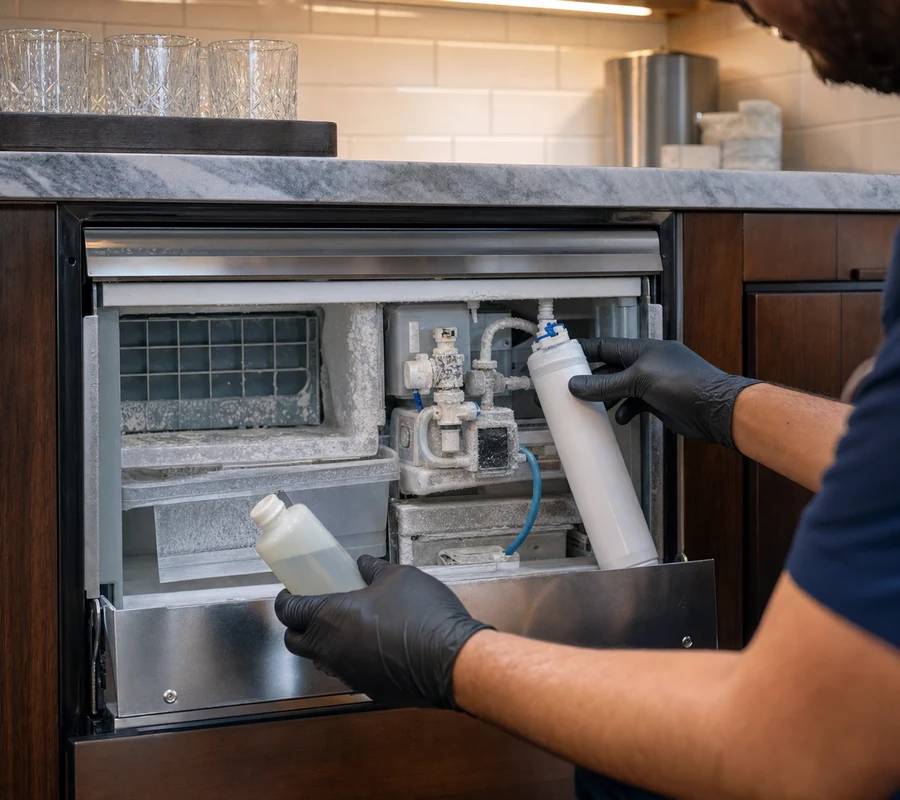
The first measurement is fill rate and cube weight. A light, hollow cube means water is reaching the mold too slowly — the scaled-valve signature on island water. We check pressure at the valve, then pull and inspect the filter, which on our aquifer is often the entire problem.
From there we descale the valve and module, flush the supply line, and sanitize the bin before testing a full harvest cycle. On a UC-15I we add the evaporator plate, the gravity drain or condensate pump, and the condenser, which packs with dust and salt in a closed wet-bar cabinet. We confirm a clean harvest before we leave, not just a single cube.
| what you notice | first check on site | likely cost lane |
|---|---|---|
| Less ice every week | Fill rate, filter age, valve scale | $250–$450 |
| Hollow or small cubes | Water pressure, inlet valve | $300–$600 |
| No ice at all, motor cycling | Module, ejector, solenoid timing | $400–$700 |
| Off-tasting or cloudy ice | Carbon filter, line flush, bin sanitation | $250–$450 |
| Standalone UC ice machine dead | Drain, pump, condenser, evaporator | $300–$650 |
Descale, replace, or rebuild — how we choose
| what we find | evidence | our call |
|---|---|---|
| Slow fill, heavy scale, old filter | Low cube weight, restricted valve | Descale and replace filter — no new module |
| Valve weeping or stuck | Leak at the bin or fill never stops | Replace the water inlet valve |
| Harvest jams every cycle | Solenoid energized over 15 seconds | Rebuild or replace the module |
| 2022+ Classic or Designer unit | Still under factory warranty | Factory Certified Service first; we handle filters and water |
Some island homes near the marshes have run on private wells over the years, and iron or sulfur stains ice differently than JEA-style hard water — we adjust the flush and filter spec when that history shows up. Pull your model and serial before booking so we load the right valve revision the first time.
Scaled valve, failed module, or starved supply?
Three island faults all read as “not enough ice,” and the wrong guess means the wrong part. Here is how the evidence separates them before we commit to a fix.
| if you see | scaled fill valve | failed module | starved water line |
|---|---|---|---|
| Cube weight | Light, hollow, thin | Normal-size but jammed | Light or none |
| Harvest motion | Cycles, fills slowly | Sticks mid-cycle | Cycles dry |
| Solenoid timing | Restricted fill | Energized past ~15 sec, faults | Valve fine, no pressure |
| First fix | Descale, then valve if needed | Rebuild or replace module | Clear filter, kink, or frozen line |
A scaled valve and a starved line both produce light cubes, so we measure water pressure at the valve to tell them apart; a true module fault is the only one of the three where the harvest motion itself stalls. That is also why our BI built-in repairs start at the valve and fill rate, not the module, nine calls out of ten.
Keeping cubes coming against 14–28 gpg water
Scale is relentless on island water, so the cure is rhythm, not a single repair. This is the maintenance cadence we leave with owners after an ice maker call.
| interval | what it covers | why it matters here |
|---|---|---|
| Every 6 months | Carbon water filter change | 14–28 gpg closes the filter twice as fast as the sticker assumes |
| Twice a year | Bin sanitize and line flush | Humid island air grows odor and biofilm in a standing bin |
| Annually | Valve and mold descale | Limestone narrows the fill path and shrinks cube weight |
| UC-15I, annually | Evaporator plate descale, drain or pump clear | Tight, salty bar cabinets clog the condenser and drain fast |
| After well-water history | Iron / sulfur flush, filter spec change | Marsh-side wells stain ice differently than JEA-style hard water |
Ice for a full house, on island time
Ice tends to fail right when the island fills up — a Plantation rental turning over, a Summer Beach holiday, a downtown porch party. Because island addresses anchor our route, a stalled ice maker in Old Town or at the Sanctuary gets a real window instead of a mainland brush-off.
For rental villas we time the visit around guest turnover and leave a written condition report; here is how we work the Plantation and Long Point. If your kitchen is in the historic district, the same standing service days apply.
Ice maker questions islanders ask
Why does my Sub-Zero make less ice every month on the island?
Our water is very hard — the Floridan aquifer runs limestone-rich, and scale slowly closes the fill valve and clogs the water filter. The mechanism is usually fine; the water path is starved. A descale of the valve and module plus a fresh filter brings most island ice makers back without new parts.
The ice tastes or smells off — is that the machine?
More often it is the water and the cabinet. A spent carbon filter, a slow fill that leaves cubes hollow, or a freezer absorbing food odors all read as bad ice. We flush the line, swap the filter, sanitize the bin, and check fill volume. If a cube weighs light, the valve is scaled and that is the real fix.
My UC-15I ice machine in the wet bar stopped — different repair?
Yes. The UC-15I is a standalone ice machine, not a fridge ice maker, and scale is its main enemy in cabinetry near the surf. We descale the evaporator plate, clear the gravity drain or pump, and clean the condenser, which clogs fast in a tight Summer Beach bar. These are common island calls.
How fast should a healthy Sub-Zero ice maker fill the bin?
A built-in module drops a harvest every 90 minutes to two hours and fills a standard bin in roughly a day. If yours takes two or three days, the fill is restricted — scaled valve, kinked or frozen line, or a filter overdue by months. We measure the fill, not guess, before naming any part.
Do you stock fill valves and filters for older 600-series ice makers?
We carry the common water inlet valves, filters, and module parts for BI and 600-series units on the van, plus descaling kits. Some 600-series ice maker parts have multiple revisions, so the model and serial help us bring the right one and finish in one trip across the bridge.
How often should I change the Sub-Zero water filter on island water?
The cartridge sticker assumes about twelve months, but our Floridan-aquifer water runs 14 to 28 grains per gallon, so a six-month change keeps the filter from choking and the cubes from shrinking. A house that runs a UC-15I bar plus a built-in goes through filters faster still — we leave a calendar reminder on the report so it does not get forgotten.
My ice maker dumps a full bin of cubes onto the floor or freezes into one block — why?
A bin of loose cubes overflowing usually means the shut-off arm or the optical level sensor is not registering a full bin, so the module keeps harvesting. Cubes fusing into a single block point at a slow harvest that lets them melt and refreeze, often from a scaled valve or a warm freezer. We test the level control and the harvest timing before deciding which one it is.
Does descaling actually work, or am I just delaying a new ice maker?
On our water descaling is the real fix far more often than a replacement. Limestone scale narrows the fill valve and coats the mold long before the mechanism wears out, so clearing it restores normal cube weight and fill time. We only move to a new valve or module when descaling does not bring the fill rate back, and we measure before and after so you can see the difference.
Related island repairs & guides
Every Sub-Zero repair we run on the island
Ready when the tide is
Mon–Fri 8am–6pm · Sat 9am–1pm · island addresses anchor every route