Sub-Zero Error & EC Codes Explained for Amelia Island
A Sub-Zero® EC code means “excessive run-time” — EC50 on the refrigerator section, EC40 on the freezer — and on Amelia Island it almost always traces to a salt-furred condenser, a stalled fan, or a hardened gasket, not a failed compressor. A dark or double-dashed panel after a storm is a brownout board lock instead. We read the code, prove the cause, and most fixes land between $250 and $1,100.
For Sub-Zero repair on Amelia Island and in Fernandina Beach, call (904) 650-0561 or Book online and we’ll route a tech across the bridge.
Amelia Island Sub-Zero Repair is an independent shop in Fernandina Beach, FL 32034, and a code on the panel is the most common reason islanders call. Reach a technician at (904) 650-0561 or hold a window through our external online booking page. Updated June 13, 2026.
Mon–Fri 8am–6pm · Sat 9am–1pm · (904) 650-0561
What each Sub-Zero signal means on the island
The same code can mean different work depending on the unit and the kitchen. These are the readings we see most across Amelia Island, with the cause we check first and the typical cost lane.
| what the panel shows | what it means | first cause we check & cost lane |
|---|---|---|
| EC50 | Refrigerator section excessive run-time | Salt-furred condenser or gasket — $250–$1,100 |
| EC40 | Freezer section excessive run-time | Condenser, fan, or freezer gasket — $250–$1,100 |
| Dark panel, interior light on | Brownout / surge board lock | Input voltage, then board — $550–$1,100 |
| Two dashes or blank readout | Board not repopulating after a flicker | Power cycle once, then board work — $550–$1,100 |
| Service light, no digital code (600-series) | Classic-unit fault flag | Probe, airflow, thermistor — $300–$700 |
| Code returns within hours of a reset | Underlying cause unfixed | Diagnose the real fault, not the code |
Straight answers about Sub-Zero codes
Why does a code matter less than the cause?
A code is a symptom, not a diagnosis. EC50 tells you the refrigerator section ran too long; it does not tell you whether a salt-crusted coil, a dead fan, or a torn gasket made it run too long — and those are three different repairs in three different cost lanes. Reset the code without fixing the cause and it comes right back. That is why our visit logs temperatures, airflow, and condenser condition before we name a part, the same diagnostic-first approach on the not-cooling page.
What is the brownout lock, and why is it an island thing?
Northeast Florida sees over a hundred thunderstorm days a year, and every outage ends with a restoration surge. That surge can lock or scramble a BI-series control board, leaving the panel dark or dashed while the interior light still works. It is a documented killer of Sub-Zero boards and one of the most common calls we get the morning after a storm — the full breakdown is on the BI-series page and the warm-after-a-power-outage page.
What does diagnosing a code cost?
One flat diagnostic fee, credited toward the repair when you approve it on the same trip. Most code-driven repairs land in the $250–$1,100 range; the rare ones that point at the sealed system are quoted only after pressure proof, in the $1,500–$3,000 lane covered on the sealed-system page and the cost guide.
Four safe steps when a code appears
None of these void anything or risk the unit. Run them, note what you find, and tell us — it often shortens the visit to one trip across the bridge.
- Write down the exact code or panel state — EC50, EC40, dark, or dashed — and whether the interior light is on.
- Note when it appeared. Right after a storm or outage points at the board; a slow build over a hot week points at the condenser.
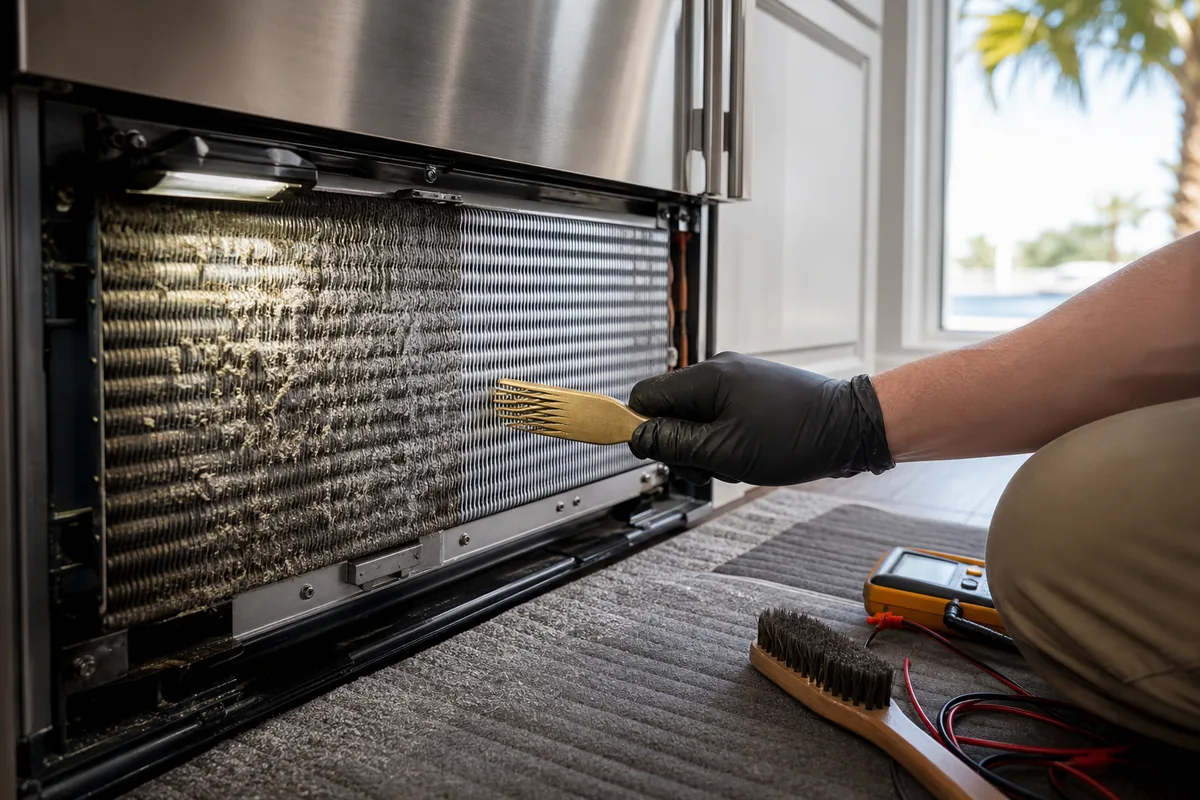
- Open the lower grille and look at the condenser. Visible salt crust and dust on the fins is the most common island cause of an EC code.
- Try one power cycle at the breaker, then leave it twenty-four hours. If the code returns, stop resetting and call — the cause needs fixing.
One call covers the bridge, the parts, and the tech.
Reading the code to the right repair
An EC code narrows the search but never ends it. We pair the readout with what the meter and the grille tell us: a compressor running steady with hot grille air and a furred coil is an EC50 caused by salt, the cheapest fix on the board. Faint airflow with a cold freezer and warm fridge is a fan or defrost fault. A panel that went dark after a storm is voltage and board work.
Only when airflow, electrical, and gasket checks all pass do we reach for the gauges — because the codes that genuinely point at the sealed system are the rare ones, and opening a sealed system you did not have to open is the most expensive mistake in this trade. Pull your model and serial before you call so we bring the right board revision and skip a second crossing.
Error-code questions islanders ask
What does an EC code mean on a Sub-Zero built-in?
EC stands for "excessive run-time" — the control board flagging that a compressor section has run far longer than it should to hold temperature. EC50 is the refrigerator section, EC40 is the freezer section. On Amelia Island the cause is almost always something stopping the unit from shedding heat or sealing in cold: a salt-furred condenser, a stalled condenser fan, or a hardened door gasket — not a dead compressor. We read the code, then prove the cause before quoting.
My panel shows two dashes or went completely dark after a storm — is that a code?
That is the brownout signature, not a numeric fault. A power flicker and the restoration surge behind it can lock or scramble a BI-series control board, so the panel goes dark or shows double dashes while the interior light still works. It is the most common "code" we see on the island after a summer storm. A single breaker cycle occasionally clears it; if the panel never repopulates, it is board work, not a setting.
Can I clear a Sub-Zero error code myself?
You can try one thing safely: a single power cycle at the breaker, then give the unit twenty-four hours to settle — that occasionally clears a confused board after a storm. What you cannot do is clear the underlying cause. An EC50 will keep coming back until the choked condenser or torn gasket behind it is fixed, so treat a returning code as a symptom to report, not a nuisance to reset over and over.
Does an error code mean an expensive repair?
Usually not. The most common island codes — EC50 and EC40 — point at a coil cleaning ($250–$550) or a gasket ($550–$1,100) far more often than anything in the sealed system. A dark or dashed panel after a storm is board-class work ($550–$1,100). The codes that genuinely point deep, toward the sealed system and its $1,500–$3,000 lane, are the rare ones, and we confirm with pressure readings before we say so.
Why does my Sub-Zero throw an EC code every summer but run fine in winter?
Heat load. A condenser half-blocked with salt and dust can still shed enough heat on a 60°F island morning, then lose the fight when the kitchen hits 80°F and the unit runs all day — long enough to trip the excessive-run-time flag. Summer is our busiest EC-code season for exactly this reason, and it is a sign the coil is overdue for a deep cleaning rather than a sign of a failing compressor.
My older 600-series has no digital codes — how do you diagnose it?
By the lights and the evidence. Classic 600-series units predate the EC code system, so instead of a panel readout they signal trouble with the magnetic service light, erratic temperatures, or a frost pattern on the evaporator. We diagnose them the old-fashioned, reliable way — temperature probe, airflow check, thermistor against a chart, and gauges only if the cheaper causes are ruled out. No code does not mean no answer.
Should I keep using the fridge while it is showing a code?
If it is still holding temperature, yes — keep the doors shut and book a visit. An EC code with the box still near set point means the unit is working harder than it should but has not failed, so you have time. If temperatures are drifting up with the code showing, treat it like a no-cool call: move perishables to a cooler after two hours above 40°F and call the island line.
Related island issues & repairs
Ready when the tide is
Mon–Fri 8am–6pm · Sat 9am–1pm · island addresses anchor every route