Sub-Zero Warm or Dark After a Power Outage on Amelia Island
A Sub-Zero® that went warm, dark, or unresponsive after a Florida storm on Amelia Island is almost always the restoration surge locking or damaging the control board — not the compressor or the refrigerant. Try one clean power cycle at the dedicated breaker and give it twenty-four hours; if the panel stays blank or shows double dashes, it is board-class work in the $550–$1,100 lane, and surge protection stops it coming back.
For Sub-Zero repair on Amelia Island and in Fernandina Beach, call (904) 650-0561 or Book online and we’ll route a tech across the bridge.
Amelia Island Sub-Zero Repair is an independent shop in Fernandina Beach, FL 32034, and a dead panel the morning after a thunderstorm is one of our most common island calls. Reach a technician at (904) 650-0561 or hold a window through our external online booking page. Updated June 13, 2026.
Mon–Fri 8am–6pm · Sat 9am–1pm · (904) 650-0561
Straight answers about a storm-struck Sub-Zero
Why does an outage warm a Sub-Zero when the power comes right back?
It is not the outage itself — it is the spike behind it. When the grid re-energizes after a flicker or a full outage, the voltage can jump fifty to a hundred percent over nominal for a fraction of a second. That restoration surge rides straight into the control board, the most sensitive thing in the cabinet. On a BI-series built-in the board responds by going into a brownout lock: low-voltage power is still present, the interior light still works, but the panel reads blank or double-dashed and the unit will not run. Northeast Florida sees over a hundred thunderstorm days a year, so this is a documented, seasonal island failure, not a fluke.
What is the difference between a lock and real surge damage?
A lock is the board confused but intact — sometimes recoverable with a clean power cycle and a settling period. Real damage is the surge actually cooking a component: the board itself, or the condenser-fan triac soldered to it, which switches the fan that sheds heat. A blown triac leaves a unit that powers up but never cools because the condenser fan never spins. We tell the two apart by checking input voltage at the unit first, then reading the board and the fan circuit before we name a part — the same diagnostic-first approach on the not-cooling page.
What does the repair cost?
If a clean power cycle and a settling period bring the unit back, you pay only the flat diagnostic fee — no part needed. If the surge damaged the board or the triac, control-board work lands in the $550–$1,100 lane depending on the board revision and how scarce it is. A storm call almost never reaches the sealed-system lane, because a surge hits electronics, not the compressor — the full picture is on the cost guide.
What the panel is telling you after the storm
The same dead fridge can mean a recoverable lock or real damage. These are the post-outage readings we see most across Amelia Island, with the cause we check first and the cost lane.
| what the panel shows | what it usually means | first cause we check & cost lane |
|---|---|---|
| Blank panel, interior light on | Brownout board lock from the restoration surge | Input voltage, then power cycle — flat diagnostic to $1,100 |
| Two dashes after the power returned | Board not repopulating after the spike | One power cycle, then board — $550–$1,100 |
| Panel lit, unit runs, but stays warm | Blown condenser-fan triac on the board | Fan circuit and triac — $550–$1,100 |
| Comes back, then goes dark again | Damaged board, not a clean lock | Board replacement, right revision |
| Service light / dead fan (600-series) | Surge hit a pre-digital board | Voltage, fan, board — $550–$1,100 |
| Recovers fully on one power cycle | Confused board, no damage | Diagnostic only — add surge protection |
Four safe steps after the power comes back
None of these void anything or risk the unit. Run them in order — cheapest cause first — note what you find, and tell us. It often shortens the visit to one trip across the bridge.
- Confirm it is the fridge and not the house: a kitchen light that works while the panel is dark is the brownout signature, not a tripped main.
- Check the unit’s dedicated breaker. If it tripped, reset it once. If it trips again immediately, stop and call — that points at a shorted component, not a lock.
- Power-cycle once: off at the breaker for two to three minutes, then back on. Give it twenty-four hours to settle before you judge it.
- If the panel never repopulates, comes back then dies, or runs warm with a dead fan, stop cycling and call. Note the storm time and whether you have surge protection.
One call covers the bridge, the parts, and the tech.
How a storm call goes out here
We start with the meter, not the board. A dead panel can be a board lock, a blown triac, a tripped breaker, or a loose neutral feeding low voltage — and they are four different repairs. We confirm the unit is actually getting a clean, full voltage first, because opening a board you did not have to open is the most expensive mistake in this trade.
With voltage confirmed, we run a clean power cycle and watch whether the board repopulates and holds. If it recovers, the fix is a settling period and a recommendation: a dedicated circuit and whole-home surge protection so the next storm does not repeat the lesson. If it stays dark, or runs warm with a stalled condenser fan, we read the board and the triac against the symptom and quote the right board revision. Pull your model and serial before you call so we cross the bridge once with the correct part on the van — the BI specifics are on the BI-series page.
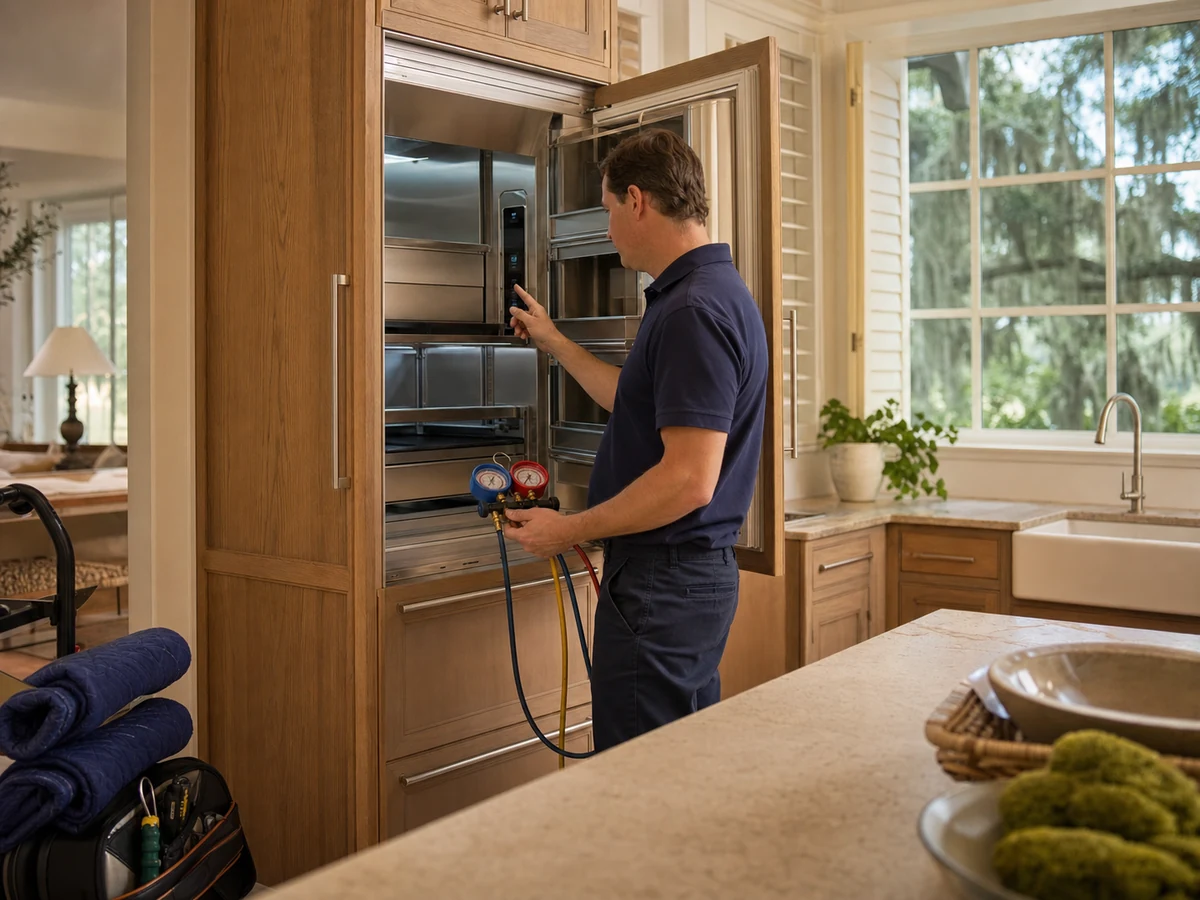
Island case notes: storm-driven panels
These are illustrative diagnostic walk-throughs built to show how a storm call reads on the island — not testimonials.
- Summer Beach, BI-36UFD, morning after a July cell. Kitchen lights fine, fridge panel blank. Voltage at the unit read clean and full; a single power cycle brought the panel back, and it held at set point after twenty-four hours. No part — just the diagnostic and a strong nudge toward surge protection on an unprotected oceanfront circuit.
- Long Point villa, BI-42S, after a multi-hour outage. Panel lit, compressor running, box stubbornly warm. The condenser fan never spun — the surge had blown the fan-driving triac on the board. Board-class repair in the $550–$1,100 lane, confirmed only after the fan circuit was metered, not guessed.
- Historic-district Victorian, classic 650, post-storm. No digital panel to read; the service light was on and the condenser fan was dead. Older wiring and an unprotected circuit took the spike. Diagnosed by voltage and fan, with a note that some 600-series boards are now rebuild-only — covered on the 600-series page.
Why island storms keep killing control boards — and how to end it
Florida leads the United States in cloud-to-ground lightning, and Northeast Florida carries over a hundred thunderstorm days a year. Every one of those storms risks an outage, and every outage ends with a restoration surge that a sensitive Sub-Zero board has to absorb. A unit on a shared, unprotected circuit takes that hit storm after storm until a board finally locks or fails for good. That is why a warm or dark Sub-Zero after a storm is a seasonal island pattern rather than bad luck.
The durable fix is not another board — it is protection ahead of the board. A dedicated circuit keeps the fridge off shared, surge-prone wiring, and whole-home surge protection (roughly $900–$1,200 installed by a licensed electrician) clamps the restoration spike before it reaches the panel. We do not sell electrical work, but we will tell you plainly when a unit is fixed and what to ask your electrician for so the next storm is a non-event. Until then, a unit that recovers on a power cycle has bought you time, not immunity.
Power-outage questions islanders ask
My Sub-Zero went dark after a lightning storm but the kitchen light still works — what happened?
That split is the classic brownout signature on a BI-series built-in. House power is fine — your kitchen light proves it — but the restoration surge that came back on the line right after the outage put the control board into a lock: lights and low-voltage power are present, yet the panel reads blank or shows double dashes and the unit will not cool. Northeast Florida runs over a hundred thunderstorm days a year, so this is one of the most common calls we get the morning after a summer storm. A single breaker cycle occasionally clears it; if the panel never repopulates, it is board-class work, not a setting.
Can I reset a Sub-Zero myself after a power outage?
You can safely try one thing: switch the unit off at its dedicated breaker, leave it off for two to three minutes, switch it back on, and then give it twenty-four hours to settle. That single power cycle occasionally clears a confused board after a flicker. What it cannot do is repair a board the surge actually damaged, or fix a blown condenser-fan triac. If the panel comes back and the unit cools, you got lucky; if it stays dark or goes dark again, stop cycling the breaker and call the island line.
Is the panel blank because the board is dead, or just locked?
Those are two different repairs and we have to tell them apart on site. A brownout lock is recoverable in some cases with a clean power cycle and a settling period. A surge that actually cooked the board — or popped the condenser-fan triac soldered to it — means the board itself, or the triac, has to be replaced. We confirm input voltage at the unit first so we are not chasing a board fault that is really a tripped breaker or a loose neutral, then read the board against the symptom before quoting.
What does the repair cost if the storm killed the board?
Control-board work on a BI or 600-series unit lands in the $550–$1,100 lane, parts and labor, depending on the board revision and how scarce it is. A simple recovery — a power cycle and a settling period with no part needed — is just the flat diagnostic fee. The expensive sealed-system lane ($1,500–$3,000) almost never applies to a storm call, because a surge hits electronics, not the compressor and refrigerant. We name the lane before any panel comes off.
Why does this keep happening to my refrigerator every storm season?
Because the unit has no surge protection and the island gets hammered. Florida leads the country in cloud-to-ground lightning, and every outage ends with a restoration spike that can run fifty to a hundred percent over nominal voltage for a fraction of a second — long enough to lock or damage a sensitive control board. A Sub-Zero on a shared, unprotected circuit takes that hit again and again. A dedicated circuit and whole-home surge protection (roughly $900–$1,200 installed by an electrician) is the only real fix for the recurrence.
Should I throw out the food while the panel is dark?
Use the two-hour rule. A full, sealed Sub-Zero holds under 40°F for four to six hours with the doors shut, so a quick outage rarely spoils anything. Once the fresh-food box has been above 40°F for two hours, move dairy, meat, and leftovers to a cooler with ice; freezer food that still has ice crystals is safe to refreeze. Keep the doors closed while you wait — every opening dumps the cold you are trying to protect.
My older 600-series acted up after the outage too — is that the same brownout problem?
The mechanism is the same surge, but a classic 600-series shows it differently. Those units predate the BI control architecture, so instead of a blank digital panel you may see the service light, a dead condenser fan, or erratic temperatures after a storm. The 600-series boards have their own surge-vulnerable components and some revisions are now scarce or rebuild-only. We diagnose them by voltage, the lights, and the fan rather than a code readout — the classic-unit walk-through lives on the 600-series page.
Related island issues & repairs
Ready when the tide is
Mon–Fri 8am–6pm · Sat 9am–1pm · island addresses anchor every route