Sub-Zero Sealed System & Compressor Repair on Amelia Island
A Sub-Zero® sealed-system or compressor failure is the deepest and most expensive refrigeration repair, running $1,500–$3,000 on Amelia Island, so we quote it only after airflow, electrical, and gauge-pressure evidence has ruled out the cheaper causes. The tell is a partial frost band on the evaporator and a low side reading low — we show you the proof before a single port is opened.
For Sub-Zero repair on Amelia Island and in Fernandina Beach, call (904) 650-0561 or Book online and we’ll route a tech across the bridge.
Amelia Island Sub-Zero Repair is an independent shop in Fernandina Beach, FL 32034, covering the whole island for the sealed-system work most outfits would rather hand off. Reach a technician at (904) 650-0561 or hold a window through our external online booking page. Updated June 13, 2026.
Mon–Fri 8am–6pm · Sat 9am–1pm · (904) 650-0561
Straight answers about sealed-system work
What exactly is the sealed system on a Sub-Zero?
It is the closed refrigerant circuit — compressor, condenser, evaporator, filter-drier, and the lines that join them — charged at the factory with a precise weight of refrigerant. Nothing in that loop is meant to be opened in normal service, which is why a leak, a dead compressor, or a blocked evaporator is in a different repair class than a fan, a board, or a gasket. On a built-in the whole circuit is tucked behind the cabinet and the toe-kick, so accessing it on an island kitchen means pulling the unit and protecting the custom millwork.
What does sealed-system work run on the island?
Most sealed-system repairs land between $1,500 and $3,000 — the top of this market’s range, because it is licensed refrigerant work with the priciest parts in the unit. Specialized refrigeration labor runs $150–$250 an hour here, and a sealed-system job is a half to full day. The full price picture sits on our Sub-Zero repair cost guide.
Why do you rule out everything else first?
Because nine warm-box calls out of ten on this island are not the sealed system. A salt-furred condenser, a stalled evaporator fan, a defrost fault, or a storm-surge board lock all mimic a refrigerant leak from the kitchen, and every one of them is a $250–$1,100 fix. Opening a sealed system you did not have to open is the most expensive mistake in this trade, so we read the not-cooling checklist to the end before we ever reach for the gauges.
What sealed-system repairs run on Amelia Island
These are planning ranges for the deepest refrigeration work; your quote follows the in-person pressure diagnosis and the model’s serial revision.
| the repair | what it involves | likely cost lane |
|---|---|---|
| Refrigerant leak repair & recharge | Find leak, braze, evacuate, new drier, weighed charge | $1,500–$2,200 |
| Evaporator replacement | Recover charge, swap evaporator, deep vacuum, recharge | $1,800–$2,600 |
| Compressor replacement | New compressor, drier, full evacuation and charge | $2,200–$3,000 |
| Filter-drier & restriction clearing | Clear a blocked drier or capillary, recharge | $1,500–$2,000 |
| Diagnostic visit (credited) | Pressure and electrical workup, written findings | $185–$250 |
How a sealed-system diagnosis goes out here
We start where the cheap answers live — the condenser and the fans — because on this island a furred coil and a tired fan account for the overwhelming majority of warm boxes. Only when airflow and electrical check out do the manifold gauges come off the truck and onto the schrader ports.
A low side that reads low, a compressor that runs without ever pulling the box to 0°F, and a partial frost band of four to eight inches on a classic evaporator together spell a refrigerant leak. We show you those readings, name the part, and then do it once and properly: recover the charge, repair the leak or swap the failed component, replace the filter-drier, pull a deep vacuum to drag out every trace of moisture, and weigh in the exact factory charge. Topping off a leak is a patch that fails by season’s end, and we do not do patches.
When sealed-system work is worth it on an island Sub-Zero
| the situation | what tips the math | our honest call |
|---|---|---|
| Classic 600-series, sound cabinet & panels | Millwork and doors are the expensive part you keep | Repair is usually the value play |
| Panel-ready built-in fitted into custom cabinetry | Replacement means refitting the millwork too | Repair the box, keep the install |
| Multiple failures on a very old unit | Board + sealed system + gaskets stacking up | We lay out both numbers honestly |
| 2012-or-newer Classic/Designer unit | Sealed system covered 12 years from purchase | Factory Certified Service first |
| Compressor failed from years of salt-hot running | Condenser neglect is the root cause | Repair, then a coil-cleaning schedule |
Island kitchens hold every Sub-Zero generation at once — a 1990s over-under in an Old Town Victorian, a last-decade BI built-in in a Summer Beach remodel, a classic 700-series in a Plantation villa — so the repair-or-replace answer is never one-size. Pull the model and serial before you call; it lets us bring the right compressor or evaporator revision and avoid a second crossing for a special-order part.
One call covers the bridge, the parts, and the tech.
Why salt air feeds the most expensive repair
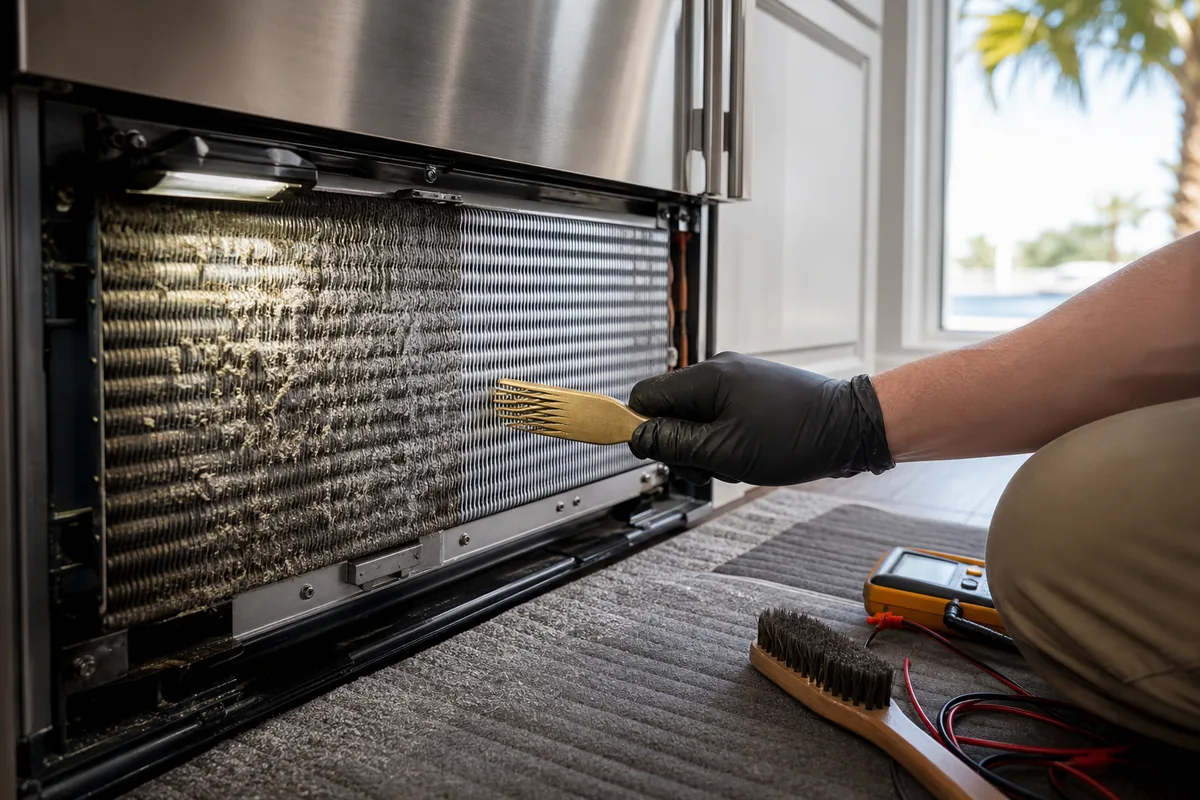
No kitchen on Amelia Island sits more than about two miles from salt water, and chloride drifts through soffit vents and louvered garage doors onto condenser fins until the coil cannot shed heat. A compressor sitting behind a half-blocked, salt-furred condenser runs hot and nearly nonstop for years — and a compressor that never rests is a compressor wearing out early. The cheap problem we keep flagging on the salt-corrosion page is the same one that, left alone, drives the $1,500–$3,000 sealed-system job.
That is why our standing advice for oceanfront kitchens — North Fletcher, Summer Beach, the south end of the Plantation — is a quarterly condenser cleaning instead of the factory’s six-to-twelve months. It is the single cheapest insurance against the most expensive failure, and it is the rhythm laid out in the salt-air survival guide.
Sealed-system questions islanders ask
How do I know if my Sub-Zero needs sealed-system work and not a cheaper repair?
You usually cannot tell from the kitchen, and that is the point — sealed-system faults look exactly like a furred condenser or a tired fan from the outside. The tell is internal: a partial frost band of four to eight inches on a classic evaporator, a low side that reads low on the gauges, and a compressor that runs forever without pulling the box to 0°F. We only name a refrigerant leak after airflow, electrical, and pressure evidence have ruled out everything simpler, and we show you the gauge readings before we quote.
Why is sealed-system repair the most expensive Sub-Zero job?
Because it is the only repair that opens the refrigerant circuit. Recovering the charge, brazing a new component, pulling a deep vacuum to remove moisture, and weighing in a precise charge is licensed, time-consuming work — often a half to full day — and the parts (compressor, evaporator, filter-drier) are the priciest in the unit. On Amelia Island most sealed-system repairs land between $1,500 and $3,000, which is exactly why we exhaust the $250–$1,100 causes first.
Is a 20-year-old Sub-Zero worth a sealed-system repair, or should I replace it?
Often it is worth it, and that surprises people. A classic 600-series or an early BI built-in was engineered for a 20–25 year service life, and the cabinet, doors, and custom panels are the expensive part you keep. If the compressor and evaporator are the only failures on an otherwise sound, panel-ready unit fitted into island cabinetry, a sealed-system repair is usually a fraction of replacing the box and refitting the millwork. We give you the honest math before you decide.
Does the salt air on the island cause sealed-system failures?
Indirectly, and it is the island story. Salt-furred condensers make the compressor run hot and nonstop for years, and a compressor that never gets to rest wears out early — so the cheap problem we keep warning about is the same one that eventually drives the expensive repair. Quarterly coil cleaning on oceanfront kitchens is the single best way to keep a sealed system out of the $1,500–$3,000 lane.
Will you recover and recharge the refrigerant properly, or just top it off?
We never just top off. A Sub-Zero is a sealed, critically-charged system, so "adding a little gas" without finding and fixing the leak is a temporary patch that fails again within months and wastes your money. We find the leak, repair it, evacuate the system to a deep vacuum to pull out moisture, replace the filter-drier, and weigh in the exact factory charge — the only way a sealed-system repair lasts.
My 2023 Sub-Zero has a sealed-system fault — what should I do first?
Check the warranty before anything. Sub-Zero covers the sealed system on Classic and Designer units for twelve years from purchase, so a 2023 unit is almost certainly inside that coverage and should go to Factory Certified Service first — a sealed-system claim is exactly what that warranty is for. We handle the maintenance and the out-of-warranty refrigeration work; we will not have you pay out of pocket for a repair the factory owes you.
How long does a sealed-system repair take, and will my food survive?
Plan on a half to full day on site, sometimes a return trip if a special-order compressor is needed for an older serial revision. Move everything to a cooler or a second fridge before we arrive, because the box will be open and warm through the work. We tell you the realistic timeline the moment the evidence points at the sealed system, so you can plan the kitchen around it.
Related island issues & repairs
Ready when the tide is
Mon–Fri 8am–6pm · Sat 9am–1pm · island addresses anchor every route