Sub-Zero Wine Storage Repair on Amelia Island
When a Sub-Zero® wine cabinet drifts off its set point on Amelia Island, the cause is usually a dual-zone thermistor reading wrong, a stuck damper, or island humidity defeating a tired door seal — rarely the compressor. Most island wine repairs run $300–$1,100 and protect the bottles before the temperature does any harm.
For Sub-Zero repair on Amelia Island and in Fernandina Beach, call (904) 650-0561 or Book online and we’ll route a tech across the bridge.
Amelia Island Sub-Zero Repair is an independent shop in Fernandina Beach, FL 32034, covering the island and its wet bars and wine rooms — the Plantation, Long Point, and Summer Beach included. Reach a technician at (904) 650-0561 or reserve a window on our external online booking page. Updated June 13, 2026.
Mon–Fri 8am–6pm · Sat 9am–1pm · (904) 650-0561
Plain answers about a drifting wine cabinet
Who repairs Sub-Zero wine cabinets on Amelia Island?
Amelia Island Sub-Zero Repair does, island-wide — Fernandina Beach 32034, the Plantation, Long Point, and Summer Beach — with a diagnostic-first visit, phone booking at (904) 650-0561, and an external online booking page for off-island owners.
What does a wine-storage visit cost?
One flat diagnostic fee, credited toward the repair when you approve it on the same trip. The visit checks both zones against a reference thermometer, reads the thermistors, and inspects the seal and ventilation before any part is named.
Why does island humidity matter so much for wine units?
Year-round humidity hardens seals and condenses on glass doors, and many island cabinets sit in hot garages or butler pantries that magnify it. Our island care guide covers the placement and seal habits that keep a cabinet steady.
Wine-storage facts worth keeping
What island wine repairs run
Planning ranges for the island; your quote follows the two-zone check and seal inspection. Specialized labor runs $150–$250 an hour in this coastal market.
| repair | what it covers | typical range | time on site |
|---|---|---|---|
| Thermistor / sensor | One zone drifting, false readings | $300–$650 | 1–2 hrs |
| Damper / zone control | Zones bleeding together, uneven temps | $350–$700 | 1–2 hrs |
| Door seal & hinge | Condensation, soft gasket, constant run | $350–$750 | 1–2 hrs |
| Evaporator / defrost icing | Frost inside, restricted airflow | $450–$1,100 | 1.5–2.5 hrs |
| Sealed system / recharge | Cannot reach set point, leak suspected | $1,500–$3,000 | half–full day |
One call covers the bridge, the parts, and the tech.
How we steady a drifting wine cabinet
We start by reading both zones against a calibrated thermometer, because a display that says 55°F and a cabinet that sits at 62°F is the whole story on a thermistor fault. We log the spread, check the damper travel on dual-zone models, and watch the evaporator fan.
Then the seal and the setting: island humidity finds every soft gasket, so we test the door pull, look for condensation tracks, and confirm the unit has the clearance Sub-Zero specifies — a cabinet crammed into a sealed pantry cannot breathe. If frost has formed inside, we clear it and trace the cause rather than just wiping it down. The bottles stay put; we confirm the set point holds across a full cycle before we leave.
| what you notice | first check on site | likely cost lane |
|---|---|---|
| One zone warm, one fine | Thermistor reading, damper travel | $300–$700 |
| Condensation on the glass door | Door seal, hinge, clearance | $350–$750 |
| Frost or ice inside | Evaporator, defrost, airflow | $450–$1,100 |
| Runs constantly, never cools enough | Condenser, seal, then sealed system | $450–$3,000 |
Repair the cabinet or rethink it — how we decide
| what we find | evidence | our call |
|---|---|---|
| Single drifting zone, sound cabinet | One thermistor off, other zone steady | Replace the sensor — quick, exact fix |
| Soft seal, sweating door | Condensation, gasket worn by humidity | New seal and hinge check |
| Unit in a hot, sealed pantry | Constant run, inadequate clearance | Fix the part, then advise on placement |
| 2022+ wine unit under warranty | Current Designer or Classic wine model | Factory Certified Service first; we maintain |
Island entertaining is hard on wine cabinets — doors opened all evening during a Summer Beach gathering, a garage unit baking through a humid August. We point out the placement and seal habits that keep a cabinet from drifting again, not just the sensor that read wrong this week.
Where a wine cabinet lives decides how long it lasts
More island wine calls trace to the location than to a failed part. Humidity, heat, and tight millwork defeat a cabinet from the outside in. This is what we check against Sub-Zero’s specs and what each location does to the unit.
| location | island risk | what it does to the unit | what we advise |
|---|---|---|---|
| Conditioned butler pantry | Low, if vented | Steady set point, long seal life | Confirm front and top clearance only |
| Beside a range or oven | High heat load | Constant run, drifts warm | Add clearance or relocate the grille path |
| Garage or summer kitchen | Heat + salt + humidity | Seal hardens, glass sweats, fan corrodes | Verify the unit is rated for the location |
| Sealed cabinet, no exhaust path | Trapped condenser heat | Reads as a dozen false faults | Open a vent path before any part swap |
Year-round humidity is the constant across all of them, which is why a tired gasket shows up as condensation on the glass long before the sealed system is ever the problem — the same humidity story our salt-air survival guide covers for the rest of the kitchen.
What a wine-cabinet visit includes, in order
We protect the bottles first and chase the cheapest likely cause before the sealed system, so the diagnosis is precise and the wine stays put.
- Read both zones against a calibrated reference thermometer and log the spread versus the display.
- On a dual-zone cabinet, watch the damper travel that splits cold air between the red and white zones.
- Check the door seal with a pull test and look for condensation tracks on the glass — humidity’s signature here.
- Confirm the cabinet has the front and top clearance Sub-Zero specifies; a choked grille mimics a refrigeration fault.
- Read the thermistors against their charts and watch the evaporator fan for a worn bearing or vibration.
- If frost has formed inside, clear it and trace the cause rather than wiping it down and leaving.
- Replace the part the evidence points to, then hold the unit across a full cycle to confirm the set point holds before we leave.
Cellars and wet bars across the island
Plenty of island homes run a wine cabinet alongside a wet-bar undercounter and ice machine, and we service them on the same visit so you are not booking the bridge twice. Island addresses anchor our route, so a drifting cabinet at the Sanctuary or in Old Town gets a real window.
For rental and second homes at the Omni Plantation and Long Point we schedule around guest turnover and leave a written condition report; here is how we work the Plantation and Long Point. Downtown Fernandina Beach kitchens share the same standing days.
Wine-storage questions islanders ask
My dual-zone Sub-Zero wine cabinet holds one zone but not the other — fixable?
Usually yes, and it is one of the more common wine calls here. A dual-zone unit runs two thermistors and a damper; when one zone drifts while the other is fine, a sensor reading wrong or a stuck damper is the typical cause. We verify each zone against a reference thermometer, then replace the part that is actually off.
There is frost or ice forming inside my wine unit — is that bad for the bottles?
It points at an evaporator or defrost fault, and yes, it stresses labels and corks over time. Island humidity makes it worse, especially in garages and butler pantries where the unit fights warm, damp air. We clear the icing, check the evaporator and door seal, and confirm the set point holds before we leave.
Why does my wine fridge sweat and the seal feel soft in summer?
Year-round island humidity is hard on wine-cabinet gaskets, and a tired seal lets warm air in, which shows up as condensation on the glass door and a unit that runs constantly. A gasket replacement and a hinge check usually settle it; we also confirm the cabinet has the breathing room Sub-Zero specifies.
Do you still service older 400-series wine units?
Yes. The 424 and 427-series cabinets from 1999 to 2016 are still in plenty of island homes, and parts like thermistors, fans, and seals are serviceable. Some are tucked into hot garages or summer kitchens, which is exactly where humidity and heat shorten their life and where our island experience helps.
How precise should the temperature actually be?
A healthy Sub-Zero wine cabinet holds its set point within a couple of degrees, with a red zone around 55°F and a white/sparkling zone in the mid-40s on dual-zone models. If yours swings several degrees or cannot reach the cooler zone, that is a thermistor, fan, or sealed-system issue worth diagnosing, not living with.
Does my Sub-Zero wine cabinet have a water filter or anything to change like a refrigerator?
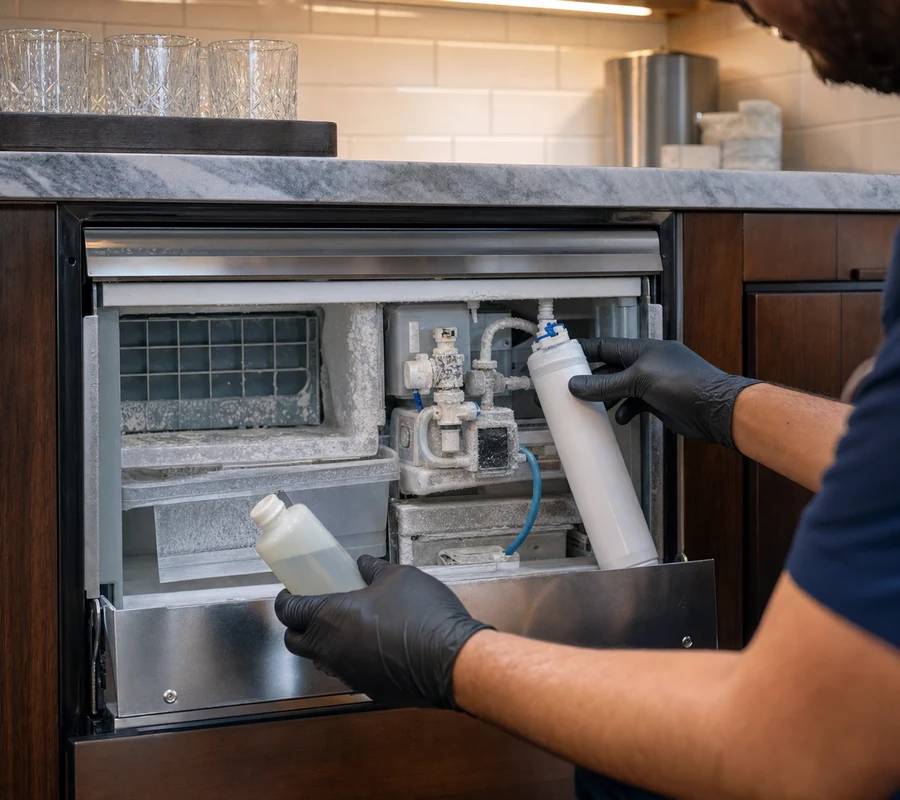
Most wine cabinets have no ice maker or water line, so there is no filter to swap, but many carry a carbon air-purification or charcoal cartridge that should be replaced about once a year to keep odors and humidity in check. In our salt and humidity that cartridge loads faster, and a tired one is a common reason a cabinet smells musty even when the temperature is fine.
My wine unit is in a butler pantry next to the oven and runs constantly — is that normal?
No, and the location is usually the reason. A wine cabinet set beside a range or in a sealed pantry absorbs ambient heat and cannot exhaust through its grille, so it runs without rest and still drifts warm. We confirm the unit has the front and top clearance Sub-Zero specifies; if the millwork chokes it, we point out the venting fix rather than chasing a part that will overwork again.
I hear the bottles rattling and a hum that vibrates the rack — what causes that?
Vibration in a Sub-Zero wine cabinet is worth chasing because it disturbs sediment in the bottles. The usual sources are an evaporator or condenser fan with a worn bearing, a compressor mount that has loosened, or racks that have shifted out of their cradles. We isolate the source, replace the fan or re-seat the mount, and re-level the cabinet so the wine sits still.
Related island repairs & guides
Every Sub-Zero repair we run on the island
Ready when the tide is
Mon–Fri 8am–6pm · Sat 9am–1pm · island addresses anchor every route