Keeping a Sub-Zero Alive in Island Salt Air
A Sub-Zero® survives Amelia Island salt air on three habits: clean the condenser on an island schedule — quarterly oceanfront — replace door gaskets before they harden at three to four years, and guard the control board against lightning surges. Do those and the unit runs its full twenty-plus years instead of burning out early.
For Sub-Zero repair on Amelia Island and in Fernandina Beach, call (904) 650-0561 or Book online and we’ll route a tech across the bridge.
This guide comes from Amelia Island Sub-Zero Repair, an independent shop in Fernandina Beach, FL 32034, covering the whole island from Old Town to the Plantation. Questions while you read? Reach a technician at (904) 650-0561 or hold a window through our external online booking page. Updated June 13, 2026.
Mon–Fri 8am–6pm · Sat 9am–1pm · (904) 650-0561
The short version, up front
What actually kills appliances on Amelia Island?
Three things, in order: salt furring the condenser until it cannot shed heat, humidity and salt hardening door gaskets, and lightning surges scrambling control boards. Each maps to a fix you can stay ahead of, which is the whole point of this guide.
How much does prevention cost versus a failure?
A condenser cleaning runs $250–$550 and a gasket kit lands in the $550–$1,100 lane. A neglected coil that wears the compressor out turns into sealed-system work at $1,500–$3,000, or a $9,000–$14,000 built-in replacement. Prevention is the cheap end of every one of those.
What can I do myself, and what should I not touch?
Clean the visible condenser grille and the gaskets; leave refrigerant, sealed systems, boards, and any pulled unit to a technician. The salt-corrosion page explains why the coil is where it all begins.
Island facts to keep on the fridge door
Keep the condenser ahead of the salt
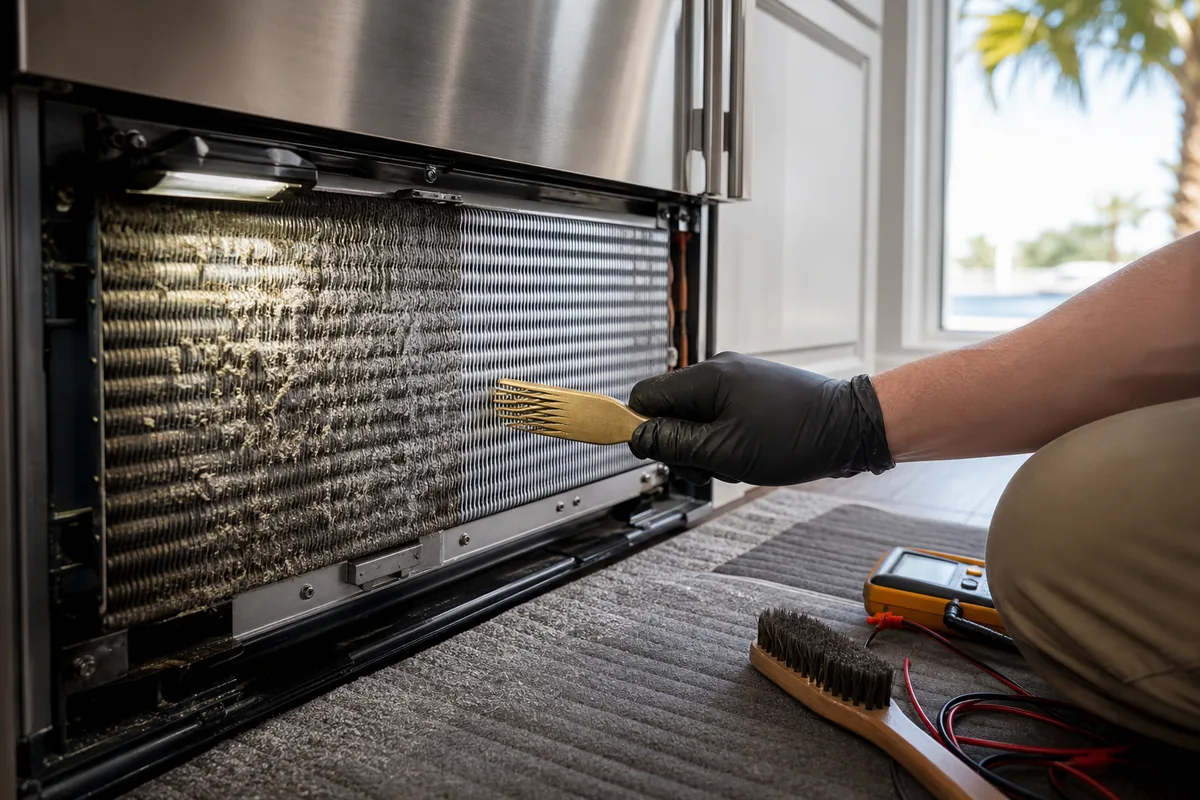
The condenser is where salt does the most damage on Amelia Island, because its fan pulls room air across the fins all day and collects whatever the onshore wind carries in. A clean coil sheds heat; a furred one traps it, so the compressor runs longer, then constantly, then loses ground on a hot afternoon and the box warms.
You can keep the visible side of this in check yourself. Pop the lower grille, vacuum the fins, and gently brush off loose salt and dust — never bend the fin stock. We handle the deep cleaning, fin treatment, and a look at the metal you cannot see. How often depends entirely on how much salt your kitchen breathes.
| where you are | salt exposure | how often to clean the coil |
|---|---|---|
| Oceanfront on North Fletcher / Summer Beach | Direct spray and heavy mist | Quarterly |
| A few blocks from the dunes | Steady onshore chloride | Every 4–6 months |
| Historic district / mid-island | Moderate, wind-dependent | Twice a year |
| Outdoor or pool-bath undercounter | Most extreme on the island | Every 2–3 months |
Replace gaskets before the humidity wins
Door gaskets are the second salt casualty. Rubber that lasts a decade in a dry inland kitchen hardens and splits in three to four years out here, where salt and year-round humidity work on it together. Once a gasket stops sealing, warm moist air leaks in, the unit sweats, frost ribbons form inside, and the condenser works harder to make up the loss — so a tired gasket quietly compounds the first problem.
Wipe gaskets with mild soapy water a few times a year so grit does not grind into the rubber, and watch for stiffness, cracks, or a door that no longer pulls shut with a firm tug. When the seal is gone we replace the full gasket kit and realign the hinges so the new one closes square — a half-seated gasket on a settled door fails again fast. This work lives alongside the refrigerator repair we do most.
Guard the board against island lightning
Northeast Florida sees more than a hundred thunderstorm days a year and leads the country in cloud-to-ground strikes, and the real damage often comes not from the strike but from the surge when power restores afterward, which can run well above nominal voltage. That spike is a documented killer of Sub-Zero control boards — especially the BI series, where the aftermath looks like a brownout lock: interior lights on, the panel and cooling dead.
Whole-home surge protection, roughly $900 to $1,200 installed, is the cheapest insurance against a board that costs hundreds and a unit that costs thousands. It matters most for island homes that sit empty during storm season, where a failure during a vacant week is not noticed until a warm box greets the next arrival. The board side of this is detailed on the BI series page, and the no-cool aftermath on the not-cooling page.
One call covers the bridge, the parts, and the tech.
What to handle yourself, and what to leave to us
| task | who should do it | why |
|---|---|---|
| Vacuum the condenser grille and fins | Owner | Safe, visible, and the single best habit |
| Wipe and inspect door gaskets | Owner | Keeps grit out and catches early hardening |
| Deep coil cleaning and fin treatment | Technician | Needs the right tools and a corrosion read |
| Gasket replacement and hinge alignment | Technician | A misaligned door reopens the leak |
| Anything sealed-system or refrigerant | Technician | Diagnostic, regulated, and tooling work |
| Surge protector installation | Licensed electrician | Whole-home protection is panel work |
The rule of thumb out here: if it is visible and dry, you can keep it clean; if it involves refrigerant, electronics, or pulling the unit, let us bring the tools across the bridge. For the resort-grade units in outdoor kitchens and wet bars — which take the worst of the salt — the undercounter and ice-machine page goes deeper on their particular care.
A season-by-season Sub-Zero checklist for the island
Salt, humidity, and lightning each peak at different times out here, so the smart maintenance year is not evenly spaced. This is the rhythm we suggest for an Amelia Island kitchen.
| season | the island risk | what to do |
|---|---|---|
| Late winter / early spring | Salt built up over a quiet season | Vacuum the grille; book the deep cleaning before summer heat |
| Late spring | Heat load about to climb | Deep condenser clean and fin treatment; check gaskets for stiffness |
| Summer (storm season) | Peak heat plus lightning surges | Confirm surge protection; oceanfront coil clean if quarterly; watch run time |
| Fall | Lingering humidity, leftover storm damage | Inspect gaskets and drains; address any board flagged after a storm |
| Before a long absence | Vacant-home exposure | Clean the coil, leave it running on surge protection, arrange a mid-stay check |
What the schedule saves: two oceanfront units, ten years
Picture two identical Sub-Zero built-ins a block apart on North Fletcher, installed the same year. The first owner cleans the condenser quarterly, wipes and replaces gaskets before they crack, and runs the unit on whole-home surge protection. Across ten years that is roughly forty cleanings in the $250–$550 lane, a couple of gasket kits, and a one-time surge guard around $900–$1,200 — and a unit that is still on its original compressor, well inside the twenty-plus-year life a Sub-Zero is built for.
The second owner skips the schedule. The coil furs unseen, the compressor logs years of extra run hours fighting trapped heat, a hardened gasket lets humid air in to make it worse, and an unprotected board takes a storm-restoration surge. The bill is a $1,500–$3,000 sealed-system repair on a worn compressor, or a replacement built-in at $9,000–$14,000 — on the same equipment, in the same salt, a block away. The only variable was the schedule. When prevention does slip and the box warms, the not-cooling walk-through sorts cause from cause before any panel comes off.
Why an island schedule is the whole secret
Most of these habits are simple; the reason island appliances die early is that nobody keeps them on a schedule. A mainland shop will not drive sixty minutes to vacuum a coil, so those cleanings never happen and a small, cheap maintenance visit becomes a warm-box emergency. Building our week around island addresses is what makes a real quarterly rhythm possible for oceanfront homes.
For owners who are not here full time, we fold maintenance into the same standing days, coordinate with caretakers and rental offices, and leave a written report after every visit. The gated south-end version of that is on the Omni Plantation and Long Point page, and downtown coverage on the Fernandina Beach page.
Salt-air care questions islanders ask
How long should a Sub-Zero last in a salt-air island home?
A well-maintained Sub-Zero runs twenty years or more even on the island, but salt shortens the careless lives sharply. The owners who get the full run are the ones who keep the condenser clean on an island schedule and replace gaskets before they fail. Neglect the coil and you trade two decades for a decade of hard-run summers.
Is there anything I can safely clean myself between technician visits?
Yes — the visible condenser grille and the door gaskets. Vacuum the lower grille and gently brush loose salt and dust from the fins, and wipe the gaskets with mild soapy water so grit does not grind into the rubber. Leave the sealed system, the refrigerant, the boards, and any unit you have to pull out alone; those are diagnostic and tooling work.
Do I really need a surge protector for a refrigerator out here?
On this island it is one of the better investments an owner can make. Northeast Florida leads the country in lightning, and the surge when power restores after a storm is a documented killer of Sub-Zero control boards. A whole-home surge protector runs roughly $900 to $1,200 installed and costs far less than the board it saves.
My island home sits empty for weeks — should I leave the Sub-Zero running?
Leave it running, but protect it. A unit left on through a vacant stretch is exposed to any storm surge with nobody there to catch a failure, so pair it with surge protection, clean the condenser before you leave, and have a caretaker or our crew check it during long absences. A warm, locked-up villa traps humid air against the coil, which does not help.
How do I know if salt damage has gone past what cleaning can fix?
You usually cannot from the front — it takes a look at the fin stock and tubing. When the fins crumble or the tubing is pitted through, the coil sheds far less heat than it should and a cleaning will not hold. That is exactly the call we make on the visit, with the corroded metal in front of you rather than a guess on the phone.
Does running the kitchen exhaust hood or a dehumidifier actually keep salt off the coil?
A little, indirectly. A range hood vented outside pulls cooking moisture out before it settles, and a dehumidifier in a closed-up island home lowers the humidity that helps salt bond and softens gaskets. Neither stops airborne chloride from reaching the condenser through soffit and garage vents, so they are useful supporting habits, not a substitute for cleaning the coil on schedule.
When in the year should I schedule the big cleaning so the unit is ready for summer?
Late spring, before the heat load peaks. A coil that coasted through cool mornings all winter is exactly the one that loses the fight in August, when the kitchen hits 80°F and the compressor runs all day. Booking the deep cleaning in May or early June gets the condenser shedding heat freely before the worst stretch, which is when most island warm-box failures actually happen.
Is stainless steel on the outside of the unit going to rust in this salt air too?
The cabinet skin can spot if salt sits on it, though it is cosmetic, not a cooling issue. Wipe exterior stainless with a damp cloth and a stainless-safe cleaner now and then, especially on units near an open patio door or an outdoor kitchen. The corrosion that actually shortens an appliance life happens out of sight at the condenser, which is why the coil schedule matters far more than the finish.
Related island guides & repairs
Every island issue, repair, and area
Ready when the tide is
Mon–Fri 8am–6pm · Sat 9am–1pm · island addresses anchor every route