Sub-Zero Not Cooling at the Omni Plantation
A Sub-Zero® that quits cooling in an Omni Amelia Island Plantation or Long Point villa is most often a surge-locked BI-series board after a power blip during a vacant week, or a salt-furred condenser by the dunes. We clear the gate, work around guest turnover, and most repairs land between $250 and $1,100.
For Sub-Zero repair on Amelia Island and in Fernandina Beach, call (904) 650-0561 or Book online and we’ll route a tech across the bridge.
Amelia Island Sub-Zero Repair is an independent shop in Fernandina Beach, FL 32034, and the south-end gated communities are part of our standing route. Reach a technician at (904) 650-0561 or hold a window through our external online booking page. Updated June 13, 2026.
Mon–Fri 8am–6pm · Sat 9am–1pm · (904) 650-0561
Plain answers for Plantation and Long Point owners
Who repairs a warm Sub-Zero at the Omni Plantation?
Amelia Island Sub-Zero Repair does, on a standing south-end route — the Omni Plantation, Long Point, Summer Beach, and the rest of the island at 32034 — with a diagnostic-first visit, phone booking at (904) 650-0561, and an external online booking page for owners and property managers off the island.
What does the diagnostic visit cost in a villa?
The same flat diagnostic fee as anywhere on the island, credited toward the repair when you approve it on the same trip. We document the model and serial, any code, input voltage, and condenser condition before naming a part — and send the written report to whoever manages the property.
What if the board is dead after an outage?
We confirm input voltage before touching the board, because a Plantation lightning surge can take more than the control. The full board-and-surge walk-through is on the BI series built-in page.
Plantation facts worth keeping
Reading a warm villa unit to the right fix
The villa context narrows the diagnosis. Empty-week failures, tight galleys, and dune-side salt all change what we look at first.
| what the villa shows | most likely cause | likely cost lane |
|---|---|---|
| Warm after a vacant week, panel dark | Surge-locked BI board after an outage | $550–$1,100 |
| Compressor running nonstop, grille hot | Salt-furred dune-side condenser | $250–$550 |
| Fridge warm, freezer fine | Evaporator fan or defrost fault | $350–$700 |
| EC50 / EC40 on a built-in display | Choked condenser or torn gasket | $250–$550 |
| Cold but never reaches 38°F | Sealed-system leak on an older villa unit | $1,500–$3,000 |
One call covers the bridge, the parts, and the tech.
How a villa no-cool visit goes at the Plantation
We start before we arrive: the model and serial you read off the grille tell us which BI or 600-series board revision to bring, since a part for one configuration may not fit the next. At the gate we check in under the owner or rental office, then keep the work clean in a galley that was never built wide.
Inside, the order follows the villa’s story. A unit warm after an empty week gets a voltage and board check first — the surge is the usual culprit. A unit that slid warm over a busy season gets the condenser and fan first, because the dune-side salt load is doing its quiet work. We carry the common boards, fans, valves, and gasket kits so most villa calls finish in one crossing, and we leave a written report for owners who live off the island.
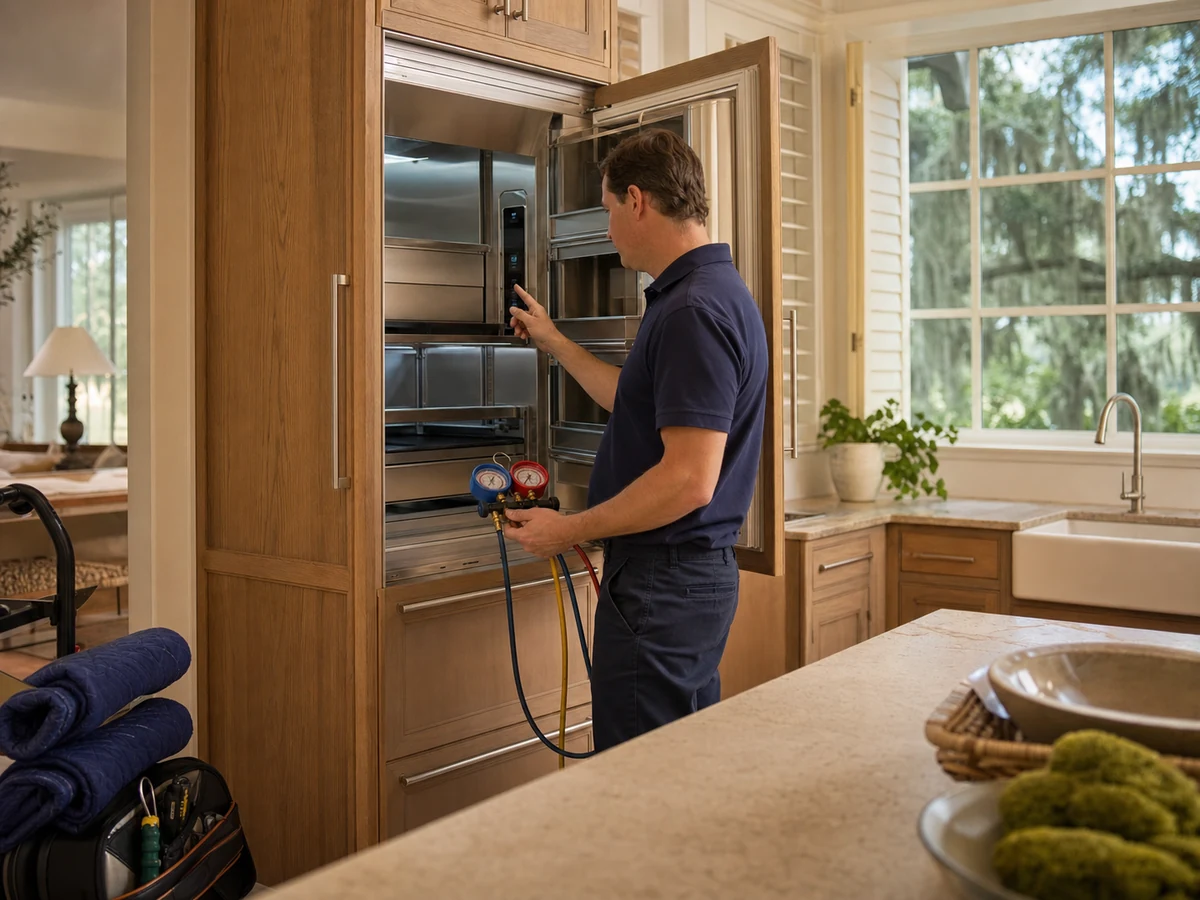
What a technician does the moment the villa door opens
A villa call has a rhythm the gate and the turnover clock dictate. This is the order the visit runs once we are cleared in and standing in the galley.
- Confirm the model and serial against the parts loaded before we left Fernandina, so the right BI or 600-series board revision is already on the van.
- Read the panel: lights-on with a dark display after a vacant week is the brownout-lock signature, and it sends us to voltage first.
- Meter input voltage at the unit before touching the board, because a Plantation surge can take start components or wiring, not just the control.
- Pull fresh-food and freezer probe readings against 38°F / 0°F to log how far the box drifted while the villa sat empty.
- Open the lower grille and check the dune-side condenser, which furs faster down here than a mid-island coil.
- Make the repair from van stock where the fault is a board, fan, valve, or gasket — the common villa failures — aiming to finish inside the turnover window.
- Leave a written condition report for the owner and the management office before the next guest checks in.
One call covers the bridge, the parts, and the tech.
How a quiet failure becomes a check-in emergency
The hardest part of a villa no-cool is that nothing is watching it. A unit can fail on a Tuesday and stay unnoticed until a Saturday arrival, which is exactly why surge protection and a standing condenser check matter more here than in an owner-occupied kitchen. The timeline below is the one we see most.
| stage | what happens in the empty villa | what would have caught it |
|---|---|---|
| Storm passes | Power blips, then restores with a surge spike | Whole-home surge protection at the panel |
| Board locks | Lights stay on, cooling and panel go dead | A scheduled mid-vacancy check by the crew |
| Box warms | Fresh food spoils with nobody there to smell it | A management walk-through before turnover |
| Guest arrives | Warm Sub-Zero and a ruined first impression | Turnover-window service the day before |
Folding these units into our standing south-end days closes that gap — the full picture of how we run the gated communities is on the Omni Plantation and Long Point page, and the lightning-and-board mechanics on the salt-air survival guide.
Why mainland shops leave Plantation calls hanging
The Omni Plantation is the far end of a forty-five to sixty minute drive for most mainland companies, and a gated check-in on top of that is exactly the call a faraway dispatcher books and quietly drops. A warm unit before a check-in cannot wait on that, which is why owners and rental offices keep coming back to a crew that actually crosses the bridge.
Because so many villas turn over to renters and sit empty between, we treat the whole south end as one standing service area — folding no-cool repairs, condenser cleanings, and gasket work into the same days. The broader picture of how we run the gated communities is on the Omni Plantation and Long Point page, and the island-wide no-cool checklist is on the main not-cooling page.
Plantation no-cool questions owners ask
Our villa sat empty for two weeks and the Sub-Zero was warm when guests arrived — what happened?
Usually a power blip while the villa was vacant. A Plantation outage and the surge behind it can lock a BI-series board so the lights stay on but cooling stops, and nobody is there to catch it. We check input voltage and the board first; when a unit fails during a vacant stretch, the timing almost always points at the electrical event, not slow wear.
Can you coordinate with the rental office and a guest turnover at the Plantation?
Yes — that is most of our south-end work. Give us the rental office or property-management contact when you book, and we schedule the repair into the turnover window so it is done before the next guest checks in. We clear the gate at the front, work clean in a tight villa galley, and leave a written report for the owner.
The villa kitchen has an older built-in from a 2000s remodel — do you still carry parts for it?
We do. Plantation villas hold every Sub-Zero generation from decades of HOA renovation cycles, so we keep common boards, fans, valves, and gasket kits for the BI and 600 series on the van. Pull the model and serial off the upper grille before you call and we will load the right board revision for that exact unit.
Why do villa units near the golf course and dunes seem to fail more often?
Salt and air movement. Long Point and the south-end villas sit close enough to the dunes that chloride drifts onto the condenser, and a closed-up villa traps warm, humid air against the coil between rentals. The combination furs the condenser faster than an inland kitchen, so the unit runs hot and eventually warms the box.
Is it worth repairing the built-in in a rental villa, or should the owner just replace it?
Almost always worth repairing. A Sub-Zero built-in is a $9,000–$14,000 replacement, and the common villa failures — a board, a fan, a gasket, a fill valve — run a few hundred to about eleven hundred dollars. We only steer an owner toward replacement when the cabinet is corroded through or several major parts have failed together, and we show the math.
Can a property manager approve the repair if the owner is unreachable during a turnover?
Yes, if you set that up at booking. Plenty of south-end owners authorize the management office to approve work up to a dollar threshold so a turnover is not held hostage to a missed phone call. Tell us who can say yes and to what limit; we document the model, the fault, and the quote, then proceed within that authority and send the report to both the owner and the office.
Should the villa Sub-Zero be left running between rentals, or shut down to save power?
Leave it running and protect it. A unit powered down between guests warms, the gaskets take a humidity set, and you lose the cold buffer if the next booking arrives early. Far better to keep it cold, pair it with whole-home surge protection against storm-restoration spikes, and have us fold a condenser check into the standing south-end days so a problem surfaces before a guest does.
A guest reported the Sub-Zero is freezing the produce instead of warming — is that the same kind of call?
Different fault, same fast response. Food freezing on the fresh-food shelves points at a stuck damper, a drifting thermistor, or a control reading the box too warm, not a cooling failure. In a rental that is still a guest-experience problem we treat on the turnover schedule. We bring thermistors and damper parts for the BI and 600 series so it usually clears in the one visit.
Related island issues & areas
Every island issue and area we cover
Ready when the tide is
Mon–Fri 8am–6pm · Sat 9am–1pm · island addresses anchor every route